Manganous Oxide
- Part number
- RXSOL-95-9504-500
- Category
- Medicine
- Brand
- RXSOL
Overview
Manganese, an essential trace element, functions as an enzyme activator and is a constituent of several enzymes. Primary signs of manganese deficiency are impaired growth, skeletal abnormalities, depressed reproductive function, ataxia of the newborn and faults in lipid and carbohydrate metabolism.
Technical specifications
MAGNESIUM OXIDE
spcification
Screen residues(75µm) % 0.01 0.5 max
Moisture % 0.6 0.1 max
Ignition loss % 5.4 8..0 max
Soluble matter in water % 0.9 1.5 max
Insoluble matter in HCL % 0.01 0.2 max
Ferric oxide and alumina % 0.10 0.3 max
Magnesium oxide % 97.9 97.0 min
bulk density g/mL 0.59 0.45-0.65
BET specific surface area m2/g 129 120min
Applications
Manganese is an essential trace element, which is necessary for cartilage development. Thus, it finds it extremely useful as a feed for various animals. As its properties contribute significantly to the ossification process, metabolism process, integrity of cellular membrane, most animal feeds use it in traces.
Manganous oxide is a safe source of manganese for all animal species/categories, provided that the current maximum total contents of manganese authorised in feed are respected. Dietary manganese does not appear to cause any adverse effects in consumers at usual intake levels; manganese intake resulting from the consumption of tissues and products of animal origin is low compared with the intake resulting from the consumption of food of plant origin. No essential differences in the manganese deposition in edible tissues and products of animal origin are expected from the use of manganous oxide compared with other inorganic manganese sources. The use of manganous oxide in animal nutrition is of no concern for the safety of consumers, provided that the current
Also Used as a fertilizer supplement -
Manganese is readily assimilated by plants in this form, so that MnO is used as a fertilizer supplement in manganese-deficient regions.
Dosage and directions
Manganous oxide is considered safe for all animal species/categories, provided that the current maximum total contents of manganese authorised in feed are respected, that is, 100 mg/kg complete feeding stuffs for fish and 150 mg/kg for other species.
The compound is produced on a large scale as a component of fertilizers and food additives.
Characteristics and notes
maximum total contents of manganese authorised in feed are respected. Handling manganous oxide is hazardous by inhalation to the user/worker; in the absence of adequate data, the additive should be considered as a potential skin and eye irritant and as a dermal sensitiser. The use of manganous oxide in animal nutrition for all animal species is not of concern for the environment, provided that the current maximum total contents of manganese authorised in feed are respected. Manganous oxide is an efficacious source of manganese in meeting the animal requirements.
Safety and SDS
Read the safety data sheet before handling. Wear suitable gloves and eye protection.
View safety data sheet
| Product Name | Manganous Oxide |
| Part Number | RXSOL-95-9504-500 |
Company Details:
RX MARINE INTERNATIONAL
105, A wing , BSEL , TECH PARK.
VASHI ,NEW BOMBAY 400703 INDIA
| Phone | +91 22 65113333 / 5555 / 27815540 -42 |
| Fax | +91 22 2781 1318 :::AOH :0091 9821214367 |
| rxsolchemicals@gmail.com |
|
Chemical Name |
Concentration |
CAS Number |
|
Manganous Oxide |
99-100 % |
1344-43-0 |
Chemical Formula : MnO
Molecular weight : 70.9374 g/mol
Potential Acute Health Effects: Hazardous in case of skin contact (irritant), of eye contact (irritant), of ingestion, of inhalation.
Potential Chronic Health Effects:
CARCINOGENIC EFFECTS: Not available. MUTAGENIC EFFECTS: Not available. TERATOGENIC EFFECTS: Not available.
DEVELOPMENTAL TOXICITY: Not available. The substance may be toxic to blood, the nervous system, liver, central nervous
system (CNS). Repeated or prolonged exposure to the substance can produce target organs damage.
|
Contact with skin |
In case of contact, immediately flush skin with plenty of water. Cover the irritated skin with an emollient. Remove contaminated clothing and shoes. Wash clothing before reuse. Thoroughly clean shoes before reuse. Get medical attention. |
|
Contact with eyes |
Check for and remove any contact lenses. In case of contact, immediately flush eyes with plenty of water for at least 15 minutes. Get medical attention. |
|
Ingestion |
Do NOT induce vomiting unless directed to do so by medical personnel. Never give anything by mouth to an unconsciousn person. If large quantities of this material are swallowed, call a physician immediately. Loosen tight clothing such as a collar, tie, belt or waistband. |
|
Inhalation |
If inhaled, remove to fresh air. If not breathing, give artificial respiration. If breathing is difficult, give oxygen. Get medical attention. |
|
General |
Not available. |
Flammability of the Product: Non-flammable.
Auto-Ignition Temperature: Not applicable.
Flash Points: Not applicable.
Flammable Limits: Not applicable.
Products of Combustion: Not available.
Fire Hazards in Presence of Various Substances: Not applicable.
Explosion Hazards in Presence of Various Substances:
Risks of explosion of the product in presence of mechanical impact: Not available. Risks of explosion of the product in
presence of static discharge: Not available.
Fire Fighting Media and Instructions: Not applicable.
Special Remarks on Fire Hazards: Contact with combustible or organic materials may cause fire.
Special Remarks on Explosion Hazards: Not available.
|
Personal Precautions |
Avoid dust formation. Avoid breathing vapours, mist or gas. For personal protection see section 8. |
|
Environmental Precautions |
Do not let product enter drains. |
|
Small Spill |
Use appropriate tools to put the spilled solid in a convenient waste disposal container. Finish cleaning by spreading water on the contaminated surface and dispose of according to local and regional authority requirements. |
|
Large Spill |
Use a shovel to put the material into a convenient waste disposal container. Finish cleaning by spreading water on the contaminated surface and allow to evacuate through the sanitary system. Be careful that the product is not present at a concentration level above TLV. Check TLV on the MSDS and with local authorities. |
|
Precuation |
Do not ingest. Do not breathe dust. Wear suitable protective clothing. In case of insufficient ventilation, wear suitable respiratory equipment. If ingested, seek medical advice immediately and show the container or the label. Avoid contact with skin and eyes. Keep away from incompatibles such as reducing agents, combustible materials, organic materials, acids. |
|
Storage |
Keep container tightly closed. Keep container in a cool, well-ventilated area. |
|
Engineering Control |
Use process enclosures, local exhaust ventilation, or other engineering controls to keep airborne levels below recommended exposure limits. If user operations generate dust, fume or mist, use ventilation to keep exposure to airborne contaminants below the exposure limit. |
|
Personal Protection |
Splash goggles. Lab coat. Dust respirator. Be sure to use an approved/certified respirator or equivalent. Gloves. |
|
Occupational exposure controls |
Splash goggles. Full suit. Dust respirator. Boots. Gloves. A self contained breathing apparatus should be used to avoid inhalation of the product. Suggested protective clothing might not be sufficient; consult a specialist BEFORE handling this product. |
| Exposure Limits |
CEIL: 5 (mg/m3) from OSHA (PEL) [United States] Inhalation TWA: 0.2 (mg/m3) from ACGIH (TLV) [United States] Inhalation Consult local authorities for acceptable exposure limits. |
Goggles
|
Odour |
Odourless |
|
Appearance |
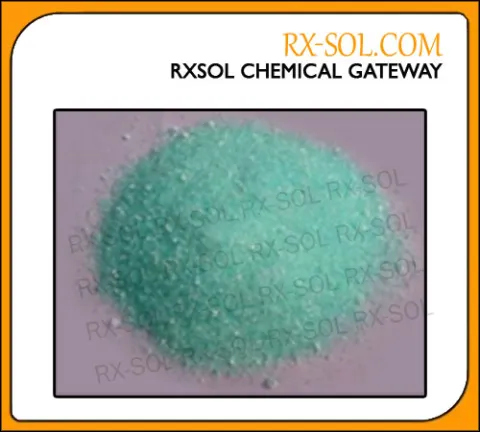
Powdered, Light Green / dark Green |
|
pH |
NA |
|
Boiling point |
NA |
|
Melting Point |
535°C (995°) |
|
Vapour pressure |
Not known |
|
Odor Threshold |
NA |
|
Specific Gravity 5.026 @ 15.6 deg. C(Water = 1) |
|
|
Vapor Density |
Not available. |
|
Solubility |
Not soluble in water |
|
Stability |
The product is stable. |
|
Instability Temperature |
Not available. |
|
Conditions of Instability |
Incompatibles |
|
Incompatibility with various substances |
Reactive with reducing agents, combustible materials, organic materials, acids. |
|
Corrosivity |
Non-corrosive in presence of glass. |
|
Special Remarks on Reactivity: |
Incompatible with easily oxidizable materials, sulfur, sulfides, phosphids, hypophosphites, chlorates, peroxides, aluminum powder, rubidium acetylide, potassium azide, chlorine trifluoride. Reacts with hydrochloric acid to form corrosive chlorine gas. Heating or rubbing with material with organic materials can cause fire hazard. |
| Polymerization |
Will not occur. |
Routes of Entry: Inhalation. Ingestion.
|
Toxicity to Animal |
Acute oral toxicity (LD50): >3478 mg/kg [Rat]. |
|
Chronic Effects on Humans |
May cause damage to the following organs: blood, the nervous system, liver, central nervous system (CNS). |
|
Other Toxic Effects on Humans |
Hazardous in case of skin contact (irritant), of ingestion, of inhalation. |
|
Special Remarks on Toxicity to Animal |
NA |
|
Special Remarks on Chronic Effects on Humans |
May cause adverse reproductive effects. Decrease of sperm count in human. |
|
Special Remarks on other Toxic Effects on Humans |
Acute Potential Health Effects: Skin: Causes skin irritation. Eyes: Causes eye irritation from mechanical action. Inhalation: Inhalation manganese oxide fume can cause "fume metal fever", a flu-like illness characterized by chills, fever, aching muscles, dryness in the mouth and throat, headache. It may irritate the respiratory tract. It may increase the incidence of upper respiratory tract and pulmonary infections. It may also cause emphysema, and acute pulmonary edema. Absorption of inorganic manganese salts through the lungs is poor, but may occur in chronic poisoning. Ingestion: May cause abdominal pain and nausea. Although manganese salts are poorly absorbed through the intestines, they may produce hypoglycemia, and decreased blood calcium levels could absorption occur. Chronic Potential Health Effects: Chronic exposure to Manganese |
|
Ecotoxicity |
NA |
|
Products of Biodegradation |
Possibly hazardous short term degradation products are not likely. However, long term degradation products may arise. |
|
Toxicity of the Products of Biodegradation. |
The products of degradation are less toxic than the product itself. |
|
Special Remarks on the Products of Biodegradation |
NA |
|
Classification |
EU Waste class: - |
|
Disposal considerations |
Waste must be disposed of in accordance with federal, state and local environmental control regulations. |
UN number
ADR/RID: - IMDG: - IATA: -
UN proper shipping name
ADR/RID: Not dangerous goods
IMDG: Not dangerous goods
IATA: Not dangerous goods
Transport hazard class(es)
ADR/RID: - IMDG: - IATA: -
Packaging group
ADR/RID: - IMDG: - IATA: -
Environmental hazards
ADR/RID: no IMDG Marine pollutant: no IATA: no
Special precautions for user
No data available`
Federal and State Regulations:
Pennsylvania RTK: Manganese dioxide New Jersey: Manganese dioxide TSCA 8(b) inventory: Manganese dioxide SARA 313 toxic chemical notification and release reporting: Manganese dioxide
Other Regulations:
OSHA: Hazardous by definition of Hazard Communication Standard (29 CFR 1910.1200). EINECS: This product is on the European Inventory of Existing Commercial Chemical Substances.
Other Classifications:
WHMIS (Canada):
CLASS D-2B: Material causing other toxic effects (TOXIC). Manganese Dioxide was tested per IATA Oxidizer test, method 3.5.1.2.1 to determine if it should be classified as an oxidizer. This material does not meet the definition of an oxidizer according to IATA Oxidizer test, method 3.5.1.2.1
DSCL (EEC):
R20/22- Harmful by inhalation and if swallowed. S25- Avoid contact with eyes.
HMIS (U.S.A.):
Health Hazard: 2
Fire Hazard: 0
Reactivity: 0
Personal Protection: E
National Fire Protection Association (U.S.A.):
Health: 2
Flammability: 0
Reactivity: 0
Specific hazard:
Protective Equipment:
Gloves. Lab coat. Dust respirator. Be sure to use an approved/certified respirator or equivalent. Wear appropriate respirator when ventilation is inadequate. Splash goggles.
The information above is believed to be accurate and represents the best information currently available to us. However, we make no warranty of merchantability or any other warranty, express or implied, with respect to such information, and we assume no liability resulting from its use. Users should make their own investigations to determine the suitability of the information for their particular purposes. In no event shall Rx Marine International be liable for any claims, losses, or damages of any third party or for lost profits or any special, indirect, incidental, consequential or exemplary damages, howsoever arising, even if Rx Marine International has been advised of the possibility of such damages.
DISCLAIMER OF LIABILITY :The information in this SDS was obtained from sources which we believe are reliable. However, the information is provided without any warranty, express or implied, regarding its correctness. The conditions or methods of handling, storage, use or disposal of the product are beyond our control and may be beyond our knowledge. For this and other reasons, we do not assume responsibility and expressly disclaim liability for loss, damage or expense arising out of or in any way connected with the handling, storage, use or disposal of the product. This MSDS was prepared and is to be used only for this product. If the product is used as a component in another product, this MSDS information may not be applicable.
Availability
Manganous Oxide manufacturer supplier distributor in Mumbai, Kandla, Kolkata, Vizag, Chennai, India, Fujairah, Dubai, Sharjah, UAE, Gulf, Middle East, Muscat Oman, Kenya Africa. Get the best quality of Manganous Oxide at a competitive price from us. We have ready stock of Manganous Oxide in India, UAE Gulf, Oman, Kenya Africa. Contact us for bulk as well as small orders.