Sodium Chlorate NOT FOR SALE
- Part number
- RXSOL-91-2977-050
- Category
- Textiles / Looms
- Brand
- RXSOL
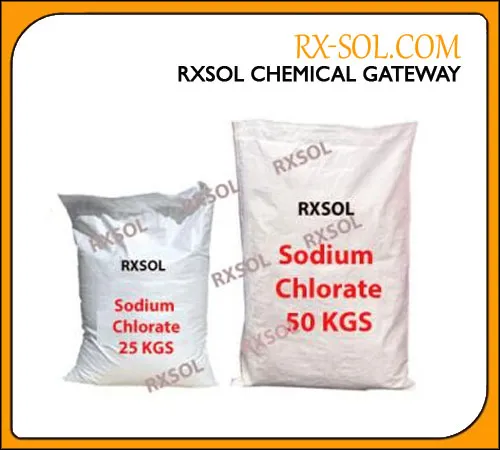
Overview
Technical specifications
|
Properties |
Technicals Grade |
Pure Grade |
|
Appearance |
Light Yellowish Crystals |
White Crystals |
|
Purity as Naclo3 |
98% + (-) 1% |
More than 99.4% |
| Nacl content | 0.5% Max. | Less than 0.1% |
| Moisture | 1-1.5% Max. | Less than 0.2% |
| Water Insoluble | 0.2 % Max. | Less than 0.05% |
| Whiteness (APHA) | --------- | Less than 17 |
Applications
Sodium Chlorate is being mainly supplied to Paper Industries for permanent whiteness to paper.
Safety and SDS
Read the safety data sheet before handling. Wear suitable gloves and eye protection.
View safety data sheet
| Product Name | Sodium Chlorate |
| Part Number | RXSOL-91-2977-050 |
Company Details:
RX MARINE INTERNATIONAL
105, A wing , BSEL , TECH PARK.
VASHI ,NEW BOMBAY 400703 INDIA
Branch : Kandla, Hazira, Mumbai, Vizag, Chennai, KolkatA, Fujairah UAE & Muscat Oman
| Phone | +91 22 27815540 /41 / 42 |
| Fax | +91 22 27815543 :::AOH :0091 9821214367 |
| rxsolchemicals@gmail.com | |
| Website | www.rxmarine.com |
| Name of Substance | Cas Number | EC Number | Wight % |
| Sodium Chlorate | 7775-09-9 | 231-887-4 | 100% |
| Signal Word | Danger |
| Hazard Statements |
H271 May cause fire or explosion; strong oxidizer. H302 Harmful if swallowed. H411 Toxic to aquatic life with long lasting effects. |
| Precautionary statements prevention |
P210 Keep away from heat/sparks/open flames/hot surfaces. No smoking. P221 Take any precaution to avoid mixing with combustibles. P273 Avoid release to the environment. |
| Precautionary statements response |
Get medical attention/advice if you feel unwell Skin : IF ON CLOTHING: Rinse immediately contaminated clothing and skin with plenty of water before removing clothes. Ingestion : IF SWALLOWED: Call a POISON CENTER or doctor/physician if you feel unwell . Fire : In case of major fire and large quantities: Evacuate area. Fight fire remotely due to the risk of explosion. In case of fire: Use CO2, dry chemical, or foam for extinction. Disposal : Dispose of contents/container to an approved waste disposal plant. |
| Eye Contact |
Rinse immediately with plenty of water, also under the eyelids, for at least 15 minutes. Get medical attention. |
| Skin Contact | In case of contact, immediately flushes skin with plenty of water for at least 15 minutes while removing contaminated clothing and shoes. Cover the irritated skin with an emollient. Cold water may be used.Wash clothing before reuse. Thoroughly clean shoes before reuse. Get medical attention. |
| Inhalation: | Move to fresh air. If breathing is difficult, give oxygen. Get medical attention immediately if symptoms occur. |
| Ingestion: | Do not induce vomiting. Obtain medical attention.If vomiting occurs, lean patient forward or place on left side (head-down position, if possible) to maintain an open airway and prevent aspiration. |
| Notes to Physician | Treat symptomatically |
| Suitable Extinguishing Media | Water spray. Carbon dioxide (CO 2). Dry chemical. Chemical foam. |
| Unsuitable Extinguishing Media | No information available |
| Flash Point | No information available |
| Method | No information available |
| Explosion Limits Upper | No information available |
| Explosion Limits Lower | No information available |
| Oxidizing Properties | Oxidizer |
| Specific Hazards Arising from the Chemical | Oxidizer: Contact with combustible/organic material may cause fire. Decomposes violently at elevated temperatures. Thermal decomposition can lead to release of irritating gases and vapors. May ignite combustibles (wood paper, oil, clothing, etc.). Hazardous Combustion Products Hydrogen chloride gas, Chlorine. Chlorine Sodium oxides. |
| Protective Equipment and Precautions for Firefighters | As in any fire, wear self-contained breathing apparatus pressure-demand, MSHA/NIOSH (approved or equivalent) and full protective gear. |
| Personal Protection : |
Advice for non-emergency personnel: Avoid inhalation of dusts. Avoid substance contact. Ensure adequate ventilation. Evacuate the danger area, observe emergency procedures, consult an expert. Advice for emergency responders: Protective equipment see section 8. |
| Environmental Precautions | Do not flush into surface water or sanitary sewer system. |
|
Methods and materials for containment and cleaning |
Avoid dust formation. Sweep up and shovel into suitable containers for disposal. Keep container tightly closed in a dry and well-ventilated place. Keep combustibles (wood, paper, oil, etc) away from spilled material. Soak up with inert absorbent material. Keep in suitable, closed containers for disposal. |
| Handling |
Wear personal protective equipment. Ensure adequate ventilation. Keep away from clothing and other combustible materials. Avoid dust formation. Do not breathe dust. Wash hands before breaks and immediately after handling the product. |
| Storage | Keep in a dry, cool and well-ventilated place. Keep container tightly closed. Do not store near combustible materials. |
| Advice | Advice on safe handling Observe label precautions. Change contaminated clothing. Wash hands after working with substance. |
| Exposure Guidelines |
This product does not contain any hazardous materials with occupational exposure limitsestablished by the region specific regulatory bodies. |
| Engineering Measures | Ensure adequate ventilation, especially in confined areas. Ensure that eyewash stations and safety showers are close to the workstation location |
| Personal Protective Equipment |
Eye/face Protection : Wear appropriate protective eyeglasses or chemical safety goggles as described by OSHA's eye and face protection regulations in 29 CFR 1910.133 or European Standard EN166 or any similat standard. Skin and body protection : Wear appropriate protective gloves and clothing to prevent skin exposure. Respiratory Protection Follow the OSHA respirator regulations found in 29 CFR 1910.134 or European Standard EN 149. Use a NIOSH/MSHA or European Standard EN 149 approved respirator if exposure limits are exceeded or if irritation or other symptoms are experienced. |
| Exposure Limit | Handle in accordance with good industrial hygiene and safety practice. |
Gloves Suit
| Form | Solid |
| Colour | Off -White |
| Odour | Odourless |
| Odor Threshold | Not Applicable |
| pH | 5 -7 at 50 g/l 20 °C |
| Melting Point | 255 °C (decomposition) |
| Boiling Point | Not Applicable |
| Flash Point | Not Applicable |
| Evaporation Rate | Not Applicable |
| Flammability (solid, gas) | No Data Available |
| Explosive limits | No Data Available |
| Vapour pressure | No Data Available |
| Vapour Density | No Data Available |
| Density | 2.49 g/cm3 at 15 °C |
| Relative Density | No information available. |
| Water Solubility | Water solubility 1,000 g/lat 20 °C |
| Auto-ignition temperature | No information available. |
| Decomposition temperature | 265 - 300 °C |
| Viscosity, dynamic | No information available. |
| Explosive properties | Not classified as explosive. |
| Oxidizing properties | The substance or mixture is classified as oxidizing with the category 1. |
| Bulk density |
ca.1,500 kg/m3 |
| Molecular Formula | Cl Na O3 |
| Molecular Weight | 106.44 |
| Reactivity | Mechanical sensitivity (friction), sensitive to shock |
| Stability | The product is chemically stable under standard ambient conditions (room temperature) . |
| Possibility of hazardous reactions |
Risk of explosion with: powdered aluminium, ammonium compounds, combustible substances, Cyanides, CALCIUM HYDRIDE, fats, rubber, Powdered metals, Sulphides, phosphorus, oils, oxidisable substances, magnesium, hypophosphites, Nitrobenzene, silicon, metallic oxides, Alkaline earth metals, semimetals, semimetallic oxides, organic nitro compounds, thiocyanates charcoal, Release of:, Oxygen sulfur, Release of:, Oxygen Acids, Release of:, chlorine dioxide sulphur dioxide, Release of:, chlorine dioxide Risk of ignition or formation of inflammable gases or vapours with: Arsenic oxides |
| Conditions to avoid | Avoid shock and friction. Strong heating. |
| Incompatible materials | No information available |
| Hazardous Polymerization |
Products in the event of fire: See section 5. |
|
Information on toxicological effects |
Acute oral toxicity : LD50 Rat: 1,200 mg/kg (RTECS) Symptoms: Irritations of mucous membranes in the mouth, pharynx, oesophagus and gastrointestinal tract. Acute inhalation toxicity Symptoms: mucosal irritations Acute dermal toxicity : LD50 Rabbit: > 10,000 mg/kg (RTECS) Skin irritation :slight irritation Eye irritation : slight irritation Sensitisation : This information is not available. Germ cell mutagenicity. Genotoxicity in vitro Mutagenicity (mammal cell test): micronucleus. Result: negative (RTECS) Carcinogenicity : Did not show carcinogenic effects in animal experiments. Reproductive toxicity : This information is not available. Teratogenicity : This information is not available. Specific target organ toxicity - single exposure This information is not available. Specific target organ toxicity - repeated exposure :This information is not available. Aspiration hazard :This information is not available. |
| Further information |
After absorption: Systemic effects: Methaemoglobinemia Other dangerous properties can not be excluded. Handle in accordance with good industrial hygiene and safety practice. |
| Toxicity |
Toxicity to fish LC50 Oncorhynchus mykiss (rainbow trout): 1,750 mg/l; 96 h (IUCLID) Toxicity to daphnia and other aquatic invertebrates EC50 Daphnia magna (Water flea): 1,093 mg/l; 24 h (IUCLID) Toxicity to algae IC5 Scenedesmus quadricauda (Green algae): 3.8 mg/l (IUCLID) |
| Persistence and degradability | No information available. |
| Bioaccumulative potential |
Partition coefficient: n-octanol/water log Pow: -7.18 (calculated) (Lit.) Bioaccumulation is not expected. |
| Mobility in soil | No Information available |
| Results of PBT and vPvB assessment | PBT/vPvB assessment not available as chemical safety assessment not required/not conducted. |
| Other adverse effects |
Additional ecological information Biological effects: Herbicide Discharge into the environment must be avoided. |
| Disposal considerations |
|
DOT
| UN Number | UN1495 |
| Proper shipping name | SODIUM CHLORATE |
| Hazard Class | 5.1 |
| Packing group | II |
TDG
| UN Number | UN1495 |
| Proper shipping name | SODIUM CHLORATE |
| Hazard Class | 5.1 |
| Packing group | II |
IATA
| UN Number | UN1495 |
| Proper shipping name | SODIUM CHLORATE |
| Hazard Class | 5.1 |
| Packing group | II |
IMDG/IMO
| UN Number | UN1495 |
| Proper shipping name | SODIUM CHLORATE |
| Hazard Class | 5.1 |
| Packing group | II |
|
Safety, health and environmental regulations/
|
National legislation Storage class 5.1A |
| Chemical Safety Assessme | For this product a chemical safety assessment was not carried out. |
| HMIS | |
| Health Hazard | : 2 |
| Fire Hazard | : 0 |
| Reactivity | : 3 |
| Personal Protection | : 1 |
| Other Information |
The information above is believed to be accurate and represents the best information currently available to us. However, we make no warranty of merchantability or any other warranty, express or implied, with respect to such information, and weassume no liability resulting from its use. Users should make their own investigations to determine the suitability of the information for their particular purposes. In no event shall be liable for any claims, losses, or damages of any third party or for lost profits or any special, indirect, incidental, consequential or exemplary damages, howsoever arising, even if Rx Marine International has been advised of the possibility of such damages. DISCLAIMER OF LIABILITY :The information in this SDS was obtained from sources which we believe are reliable. However, the information is provided without any warranty, express or implied, regarding its correctness. The conditions or methods of handling, storage, use or disposal of the product are beyond our control and may be beyond our knowledge. For this and other reasons, we do not assume responsibility and expressly disclaim liability for loss, damage or expense arising out of or in any way connected with the handling, storage, use or disposal of the product. This MSDS was prepared and is to be used only for this product. If the product is used as a component in another product, this MSDS information may not be applicable. |
Availability
Sodium Chlorate NOT FOR SALE manufacturer supplier distributor in Mumbai, Kandla, Kolkata, Vizag, Chennai, India, Fujairah, Dubai, Sharjah, UAE, Gulf, Middle East, Muscat Oman, Kenya Africa. Get the best quality of Sodium Chlorate NOT FOR SALE at a competitive price from us. We have ready stock of Sodium Chlorate NOT FOR SALE in India, UAE Gulf, Oman, Kenya Africa. Contact us for bulk as well as small orders.