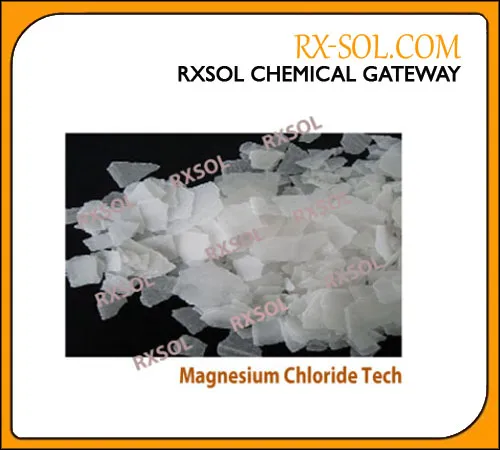
Magnesium chloride Tech
- Part number
- RXSOL-67-1912-025
- Category
- Construction Chem
- Brand
- RXSOL
Overview
Magnesium chloride manufacturer, Supplier and Exporter. Magnesium Chloride Magnesium chloride is most commonly used for dust control and road stabilisation. Its second-most common use is ice control.
Technical specifications
Product Specification
| Product Number | ||| |
|---|
M8266
| CAS Number | ||| |
|---|
7786-30-3
| MDL | ||| |
|---|
MFCD00011106
| Formula | ||| |
|---|
Cl2Mg
| Formula Weight | ||| |
|---|
Applications
1.Magnesium Chloride Flakes/ Prills 43-46% Min for Food Grade and Industry Grade
2.Calcium chloride Food and Feed Grade and Industry Grade
(1) MODEL: 74%, 77%, 94%,Calcium Chloride
(2) Variety: Flakes, Prills, Granules, Powder form
(3) Packing: 25 Kg PP Bags /1MT Jumbo Bags
Of course, the good quality, delivery in time and competitive price are the advantageous of us.
Dosage and directions
Magnesium chloride serves as precursor to other magnesium compounds, for example by precipitation:
MgCl2(aq) + Ca(OH)2(aq) → Mg(OH)2(s) + CaCl2(aq)
It can be electrolysed to give magnesium metal:
MgCl2(l) → Mg(l) + Cl2(g)
Characteristics and notes
Safety and SDS
Read the safety data sheet before handling. Wear suitable gloves and eye protection.
View safety data sheet
| Product Name |
Magnesium chloride |
| Product Type | RXSOL-67-1912-025 |
Company Details:
RX MARINE INTERNATIONAL
105, A wing , BSEL , TECH PARK.
VASHI ,NEW BOMBAY 400703 INDIA
| Phone | +91 22 27815540 / 41 / 42 |
| Fax | +91 22 2781 1318 :::AOH :0091 9322594669 |
| rxsolchemicals@gmail.com |
| Name | CAS # | % by Weight |
| Magnesium chloride hexahydrate | 7791-18-6 | 100 |
Toxicological Data on Ingredients:
Not applicable.
Potential Acute Health Effects:
Slightly hazardous in case of skin contact (irritant, permeator), of eye contact (irritant), of ingestion, of inhalation.
Potential Chronic Health Effects:
CARCINOGENIC EFFECTS: Not available. MUTAGENIC EFFECTS: Not available. TERATOGENIC EFFECTS: Not available. DEVELOPMENTAL TOXICITY: Not available. The substance is toxic to cardiovascular system, upper respiratory tract. Repeated or prolonged exposure to the substance can produce target organs damage.
| Eye Contact: | Immediately flush eyes with running water for at least 15 minutes, keeping eyelids open. Cold water may be used. |
| Skin Contact: | After contact with skin, wash immediately with plenty of water. Gently and thoroughly wash the contaminated skin with running water and non-abrasive soap. Be particularly careful to clean folds, crevices, creases and groin. Cold water may be used. Cover the irritated skin with an emollient. If irritation persists, seek medical attention. |
| Serious Skin Contact: | Not available. |
| Inhalation: | Allow the victim to rest in a well ventilated area. Seek immediate medical attention. |
| Serious Inhalation: | Not available. |
| Ingestion: | Do not induce vomiting. Loosen tight clothing such as a collar, tie, belt or waistband. If the victim is not breathing, perform mouth-to-mouth resuscitation. Seek immediate medical attention. |
| Serious Ingestion: | Not available. |
| Flammability of the Product: | Non-flammable. |
| Auto-Ignition Temperature: | Not applicable. |
| Flash Points: | Not applicable. |
| Flammable Limits: | Not applicable. |
| Products of Combustion: | Not available. |
| Fire Hazards in Presence of Various Substances: | Not applicable. |
| Explosion Hazards in Presence of Various Substances: | Risks of explosion of the product in presence of mechanical impact: Not available. Risks of explosion of the product in presence of static discharge: Not available. |
| Fire Fighting Media and Instructions: | Not applicable. |
| Special Remarks on Fire Hazards: | Not available. |
| Special Remarks on Explosion Hazards: | Not available. |
| Small Spill: | Use appropriate tools to put the spilled solid in a convenient waste disposal container. Finish cleaning by spreading water on the contaminated surface and dispose of according to local and regional authority requirements. |
| Large Spill: | Use a shovel to put the material into a convenient waste disposal container. Finish cleaning by spreading water on the contaminated surface and allow to evacuate through the sanitary system. |
Precautions:
Do not ingest. Do not breathe dust. If ingested, seek medical advice immediately and show the container or the label. Keep away from incompatibles such as oxidizing agents.
Storage:
No specific storage is required. Use shelves or cabinets sturdy enough to bear the weight of the chemicals. Be sure that it is not necessary to strain to reach materials, and that shelves are not overloaded.
Engineering Controls:
Use process enclosures, local exhaust ventilation, or other engineering controls to keep airborne levels below recommended exposure limits. If user operations generate dust, fume or mist, use ventilation to keep exposure to airborne contaminants below the exposure limit.
Personal Protection:
Safety glasses. Lab coat. Dust respirator. Be sure to use an approved/certified respirator or equivalent. Gloves.
Personal Protection in Case of a Large Spill:
Splash goggles. Full suit. Dust respirator. Boots. Gloves. A self contained breathing apparatus should be used to avoid inhalation of the product. Suggested protective clothing might not be sufficient; consult a specialist BEFORE handling this product.
Exposure Limits:
Not available.
| Physical state and appearance: | Solid. (Deliquescent crystals solid.) |
| Odor: | Not available. |
| Taste: | Not available. |
| Molecular Weight: | 203.3 g/mole |
| Color: | Not available. |
| pH (1% soln/water): | 7 [Neutral.] |
| Boiling Point: | Not available. |
| Melting Point: | 118°C (244.4°F) |
| Critical Temperature: | Not available. |
| Specific Gravity: | 1.59 (Water = 1) |
| Vapor Pressure: | Not applicable. |
| Vapor Density: | Not available. |
| Volatility: | Not available. |
| Odor Threshold: | Not available. |
| Water/Oil Dist. Coeff.: | Not available. |
| Ionicity (in Water): | Not available. |
| Dispersion Properties: | See solubility in water, methanol. |
| Solubility: | Easily soluble in cold water, hot water, methanol. Insoluble in diethyl ether, n-octanol. |
| Stability: | The product is stable. |
| Instability Temperature: | Not available. |
| Conditions of Instability: | Not available. |
| Incompatibility with various substances: | Reactive with oxidizing agents. Non-reactive with moisture. |
| Corrosivity: | Non-corrosive in presence of glass. |
| Special Remarks on Reactivity: | Not available. |
| Special Remarks on Corrosivity: | Not available. |
| Polymerization: | No. |
| Routes of Entry: | Absorbed through skin. Eye contact. Inhalation. Ingestion. |
| Toxicity to Animals: | Acute oral toxicity (LD50): 8100 mg/kg [Rat.]. |
| Chronic Effects on Humans: | The substance is toxic to cardiovascular system, upper respiratory tract. |
| Other Toxic Effects on Humans: | Slightly hazardous in case of skin contact (irritant, permeator), of ingestion, of inhalation. |
| Special Remarks on Toxicity to Animals: | Not available. |
| Special Remarks on Chronic Effects on Humans: | Not available. |
|
Special Remarks on other Toxic Effects on Humans: |
Material is irritating to mucous membranes and upper respiratory tract. |
| Ecotoxicity: | Not available. |
| BOD5 and COD: | Not available. |
| Products of Biodegradation: | Possibly hazardous short term degradation products are not likely. However, long term degradation products may arise. |
| Toxicity of the Products of Biodegradation: | The products of degradation are more toxic. |
| Special Remarks on the Products of Biodegradation: | Not available. |
NA
| DOT Classification: | Not a DOT controlled material (United States). |
| Identification: | Not applicable. |
| Special Provisions for Transport: | Not applicable. |
Federal and State Regulations:
California prop. 65: This product contains the following ingredients for which the State of California has found to cause cancer, birth defects or other reproductive harm, which would require a warning under the statute: Magnesium chloride hexahydrate California prop. 65: This product contains the following ingredients for which the State of California has found to cause cancer which would require a warning under the statute: Magnesium chloride hexahydrate TSCA 8(b) inventory: Magnesium chloride hexahydrate
Other Regulations:
Not available.
Other Classifications:
WHMIS (Canada):
Not controlled under WHMIS (Canada).
DSCL (EEC):
This product is not classified according to the EU regulations.
HMIS (U.S.A.):
| Health Hazard: | 2 |
| Fire Hazard: | 0 |
| Reactivity: | 0 |
| Personal Protection: | E |
National Fire Protection Association (U.S.A.):
| Health: | 2 |
| Flammability: | 0 |
| Reactivity: | 0 |
| Specific hazard: |
Protective Equipment:
Gloves. Lab coat. Dust respirator. Be sure to use an approved/certified respirator or equivalent. Safety glasses.
The information provided about the product on this Safety Data Sheet has been compiled from knowledge of the individual constituents The data given here is based on current knowledge and experience. This Safety Data Sheet describes the product in terms of safety requirements and does not signify any warranty with regard to the product's properties The data given here only applies when product used for proper application(s). The product is not sold as suitable for other applications usage in such may cause risks not mentioned in this sheet. Do not use for other application(s) without seeking advice from manufacturer.
DISCLAIMER OF LIABILITY :The information in this SDS was obtained from sources which we believe are reliable. However, the information is provided without any warranty, express or implied, regarding its correctness. The conditions or methods of handling, storage, use or disposal of the product are beyond our control and may be beyond our knowledge. For this and other reasons, we do not assume responsibility and expressly disclaim liability for loss, damage or expense arising out of or in any way connected with the handling, storage, use or disposal of the product. This MSDS was prepared and is to be used only for this product. If the product is used as a component in another product, this MSDS information may not be applicable.
Availability
magnesium chloride liquid applyied as de-icer to city streets. Magnesium chloride is used for low-temperature de-icing of highways, sidewalks, and parking lots. When highways are treacherous due to icy conditions, magnesium chloride helps to prevent the ice bond, allowing snow plows to clear the roads more efficiently.
» Use in hydrogen storage
Magnesium chloride has shown promise as a storage material for hydrogen. Ammonia, which is rich in hydrogen atoms, is used as an intermediate storage material. Ammonia can be effectively absorbed onto solid magnesium chloride, forming Mg(NH3)6Cl2. Ammonia is released by mild heat, and is then passed through a catalyst to give hydrogen gas.
» Gardening and Horticulture
Because magnesium is a mobile nutrient, magnesium chloride can be effectively used as a substitute for magnesium sulfate (Epsom salt) to help correct magnesium deficiency in plants via foliar feeding. It is advisable to use a smaller dose when using magnesium chloride compared to the recommended dose of magnesium sulfate (20 g/L).
» Use in dust and erosion control
Magnesium chloride is one of many substances used for dust control, soil stabilization and wind erosion mitigation.
» As a Dust Suppressant
Due to its extreme hygroscopic nature and being environmentally-friendly, it is used in many countries as a dust suppressant or dust binder on dusty roads, unpaved helipads, inside mine shafts and tunnels, open-cast iron ore and coal mines or where volcanic dust could pose a problem, in thickly wooded areas where flying dust could spoil trees etc, by using a solution or MgCl26H20 with water. Application is by simple apparatus of a road tanker with a spray boom.
» As A De-icing Compound
One of the major uses all over the world is as a de-icing compound. Being completely environmentally-friendly, it is used extensively to keep outdoor surfaces around hotels, private homes as well as roads, etc. free of ice, especially at ski-resorts in Europe, Korea and Japan. The other de-icers which have high sodium content can pollute underground water resources and destroy vegetation.
» Hypomagnesaemia
Extensively used for the treatment of Hypomagnesaemia (Grass Tetany or Grass Staggers. Recent research has proved that this condition, mainly in cattle and sheep follows after winter when a herd is turned out to lush spring grass. Hypomagnesaemia is more noticeable in cattle grazing on pastures which have recently received a dressing of nitrogenous or potash fertilizer. By spraying a solution of magnesium chloride on grass or even directly on the animal or mixed into the cattle feed, this condition is prevented and has proved to be extremely beneficial to livestock. Magnesium Chloride being environmentally-friendly, will not damage either grasslands or the cattle.
» Industrial Flooring
It is used in industrial floorings, ship decks, railway coach floorings,
hospital floors and for aircraft hangar floors, ammunition factory floors, missile silos and underground armament factories and bunkers. The famous Siegfried Line of WW-II on the border of Germany and France had its entire floor rendering of this cement.
» Medical Benefits
Magnesium Chloride is used in the manufacture of Magnesium Hydroxide Mg(OH)2 for further preparation of antacids for relieving stomach ailments and ulcers.
From research by well-known French surgeon, Prof. Pierre Delbet, MD, as reported by Dr. Walter Last, who himself claims that "magnesium chloride is nothing short of a miracle mineral in its healing effect on a wide range of diseases as well as in its ability to rejuvenate the ageing body". Prof. Delbet's list includes diseases of the digestive tract such as colitis and gall bladder problems, Parkinson's disease, tremors and muscle cramps, acne, eczema, psoriasis, warts and itching skin, impotence, prostatic hypertrophy, cerebral andcirculatory problems,asthma, hay fever, urticaria and anphylactic reactions. Hair and nails became stronger and healthier, and patients have more energy.
In recent years Dr. Vergini and others have confirmed these earlier results and have added more diseases to the list of successful uses, acute asthma attacks, shock, tetanus, herpes zoster, acute and chronic conjunctivitis, optic neuritis, rheumatic diseases, many allergic diseases, chronic fatigue syndrome and beneficial effects in cancer therapy. In all these cases magnesium chloride had been used giving much better results than other magnesium compounds.
It is proved that many of the symptoms of Parkinson's disease can be overcome with high magnesium supplementation, shaking can be prevented and rigidity eased.
» Magnesium for the heart:
Adequate levels of magnesium are essential for the heart muscles. It was found that those who die from heart attacks have very low magnesium but high calcium levels in their heart muscles. Patients with coronary heart disease who have been treated with large amounts of magnesium survived better than those with other drug treatment. Magnesium dilates the arteries of the hearts and lowers cholesterol and fat levels.
» As a Flame Retardant
One of the most important uses of Magnesium Hydroxide today in Europe and America is as a flame retardant in polymers. Recent regulation in the West to ban or curtail the use of halogenated retardants (considered carcinogenic) has increased the demand for Mg(OH)2 retardants, going up to several thousand tonnes per year. Mg(OH)2 withstands up to 340°C and has been used as an effective flame retardant particularly for poly- oleofins. The Asahi Glass company in Tokyo manufacture a range of magnesium hydroxides for flame retardant applications and are potential customers for magnesium chloride. The main suppliers in Europe are Kyowa Chemical Industry (Kagowa) of Japan.
» Impact-proof, fire-retardant, anti-static flooring
Another major use is in the preparation of oxychloride cements (3MgO MgCl2 11H2O) which are made up in carefully balanced proportions of Magnesium Chloride and a dry mix consisting of calcined magnesium oxide (MgO) or Magnesite, with fillers and other aggregates depending upon the requirement. These cements are fast setting and form a dense stone like product of smooth texture which is very strong, impact resistant, fire retardant and non sparking (antistatic).
Magnesium oxychloride Cement (3MgO MgCl2> 11H2>O) is a tough stone-like, fire-proof compound that can be used for light or heavy floorings. Having a tremendous load bearing capacity. It can withstand vibrations from heavy iron wheel movement without any trace of cracks or fissures. It is ideal for coating wooden floors, theatre stages and renovating old lofts. Oil and grease stains can be rubbed off easily without leaving any marks on it.