CITRIC ACID ANHYDROUS
- Part number
- RXSOL-41-8668-025
- Category
- Air Lines
- Brand
- RXSOL
Overview
CITRIC ACID is a source of hydrogen ions (H+) used to reduce the pH of a drilling fluid. Both liquid and powdered. CITRIC ACID provides a layer of hydrogen ions around active clays, reducing their zeta potential and thus reducing their ability to imbibe water. This function translates to fewer solids, less swelling of the solids in the drilling fluid, reduced wellbore swelling, and more efficient solids control equipment function. A secondary benefit of CITRIC ACID is the formation of sodium citrate, a thinner. This helps counteract the flocculating influence of the hydrogen ions on first being introduced to the drilling fluid system.
Application – Pipe cleaning in Aircraft
Technical specifications
Citric Acid Anhydrous
Molecular Formula C6H8O7
Molecular Weight 192.13
CAS Number 77-92-9
Product Specifications
Assay (%) 99.5 – 100.5
Water (%) 0.5 max
Identification Passes USP/FCC tests
Residue on Ignition (%) 0.05 max
Oxalate/Oxalic Acid (%) 0.036 max
Sulfate (%) 0.015 max
Arsenic (ppm) 1 max
Heavy Metals (ppm) 5 max / FCC IV Ed.
Lead (ppm) 0.5 max
Readily Carbonizable
Substances Passes USP and FCC tests
Tridodecylamine (ppm) 0.1 max
Color & Clarity Passes USP Tests
Particle Size Distribution
Granular Max. 1% on U.S. No. 16 sieve Max. 10% through U.S. No. 50 sieve
Fine Granular Max. 1% on U.S. No. 30 sieve Max. 5% through U.S. No. 100 sieve
Powder Max. 5% on U.S. No. 60 sieve Min. 25% through U.S. No. 200 sieve
Bulk Densities Granular 56 (lbs/ft3 ) Fine Granular 54
Packaging 25 Kg : Polyethylene-lined multiwall paper bags: 50 lb (22.7 Kg) Polyethylene-lined multiwall paper bags
Shelf Life and Storage
We recommend that product held for more than 5 years be reevaluated for fitness of use. Anhydrous Citric Acid is slightly hydroscopic and should be stored under conditions of low temperature and low humidity in airtight containers to prevent caking.
Applications
Uses
CITRIC ACID is primarily used as a pH buffer, a low solids, non-dispersed, low pH drilling fluid
CITRIC ACID CR20A
Dosage and directions
CITRIC ACID is a source of hydrogen ions (H+) used to reduce the pH of a drilling fluid. Both liquid and powdered.
Benefits
CITRIC ACID is primarily used to quickly reduce the pH in drilling fluid. One of the benefits of using Citric Acid is that it forms Sodium Citrate in the presence of Sodium based polymers such as DMA and OMNIPOL II. Sodium Citrate acts as a dispersant in water based fluids, helping to control the rheology. A third benefit of CITRIC ACID is the reduced hazard to personnel when compared to other acids normally used in drilling applications. CITRIC ACID will not reduce hardness levels in drilling fluids as will phosphoric acid.
Treatment
CITRIC ACID is added through the hopper when using the dry material, and added directly to the drilling fluid when using the liquid. A diaphragm-metering pump may be utilized with the liquid for continuous pH control.
Treatment levels vary with the concentration of salts, particularly hydrogen (H+) and hydroxide (OH- ).
Function
CITRIC ACID provides a layer of hydrogen ions around active clays, reducing their zeta potential and thus reducing their ability to imbibe water. This function translates to fewer solids, less swelling of the solids in the drilling fluid, reduced wellbore swelling, and more efficient solids control equipment function. A secondary benefit of CITRIC ACID is the formation of sodium citrate, a thinner. This helps counteract the flocculating influence of the hydrogen ions on first being introduced to the drilling fluid system.
Characteristics and notes
Typical Physical Properties
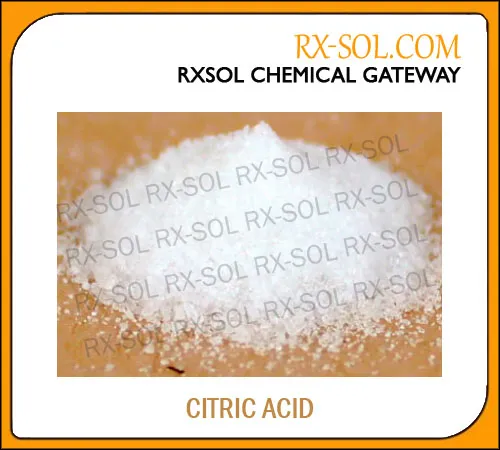
Physical Appearance………White powder or clear liquid
Specific Gravity……………..1.542
Bulk Density…………………63 lb/ft³
Hygroscopic…………………slightly
pH in water………………….1.87
Packaging
CITRIC ACID is packaged in 25 kgs multi-wall bags.
Citric Acid in 25 kg bags
| Application: | Additive for drilling and work over fluids for iron sequestration |
| Scientific name: | Citric Acid |
| Appearance: | Free flowing white solid crystalline powder |
| Safety, hazard: | Non-combustible, toxic fumes |
| Environmental, hazard: | Insignificant. Toxic to aquatic life |
| Waste disposal procedures: | At controlled landfill site |
| Form of supply: |
25 kg bags |
Safety and SDS
Read the safety data sheet before handling. Wear suitable gloves and eye protection.
View safety data sheet
| Product Name | CITRIC ACID CR20A |
| Product Type | RXSOL-41-8668-025 |
Company Details:
RX MARINE INTERNATIONAL
105, A wing , BSEL , TECH PARK.
VASHI ,NEW BOMBAY 400703 INDIA
Stock Point : Mumbai, Kandla, Kolkata, Chennai, Vizag, Fujairah, Muscat, Nairobi
| Phone | +91 22 65113333/ 5555 / 9999 / 27611360 / 27815540 |
| Fax | +91 22 2781 1318 :::AOH :0091 9322594669 |
| rxsolchemicals@gmail.com |
HAZARDOUS INGREDIENTS: OSHA PEL TLV
Citric Acid (CAS #77-92-9) N/E N/ESECTION 3:
IMMEDIATE HEALTH EFFECTS
PRIMARY ROUTES OF ENTRY: Eyes, skin contact/absorption, inhalation or ingestion.
SIGNS/SYMPTOMS OF OVEREXPOSURE: Irritation to the skin, eyes, nose, throat, and respiratory tract.
TARGET ORGAN EFFECTS: Irritation of the skin and eyes. Irritation of lungs possible if powder is inhaled.
REPRODUCTIVE/DEVELOPMENTAL INFORMATION: No data available.
CARCINOGENICITY:
NTP: Known – No; Anticipated – No OSHA: No IARC: No
LONG TERM EFFECTS: No data available.SECTION 4:
EYES: Flush eyes with water for at least 15 minutes. If irritation persists, consult a physician.
SKIN: If irritation occurs, flush skin with water for at least 15 minutes. If irritation persists, consult a physician
INHALATION: If symptoms of overexposure develop, remove to fresh air. If symptoms persist, consult a physician.
INGESTION: Give 8 to 16 ounces of water to dilute substance. Do not induce vomiting. Consult a physician or local Poison Control Center. Never give anything by mouth to an unconscious person.
Flash Point: 128 ° F
Boiling Point: N/E
Extinguishing Media: Foam, CO2, dry chemical, water fog.
Special Fire Fighting Procedures: Fire fighters should wear self-contained breathing apparatus and full protective clothing. Use water spray to cool area.
Unusual Fire and Explosion Hazards: Extinguish all nearby sources of ignition because vapors may be carried by air currents. Keep away from heat, sparks and open flame.
Personal precautions: Use personal protective equipment. Avoid contact with skin and eyes.
Environmental precautions: No special environmental precautions required.
Methods for cleaning up: Sweep up and shovel. After cleaning, flush away traces with water.
Handling
Technical measures/Precautions: Avoid dust formation.
Take precautionary measures against static discharges.
Safe handling advice: Use personal protective equipment.
Storage Technical measures/Storage conditions: Keep tightly closed in a dry and cool place.
Incompatible products: Strong oxidizing agents, strong bases.
Respiratory Protection: Not usually needed.
Protective Clothing: Rubber gloves, Safety glasses and clothing that will minimize skin contact.
Ventilation: Normal room ventilation is usually sufficient.
Storage: Store in dry place away from excessive heat, in original container. Reseal container after use.
| Odor : | Mild acidic |
| Physical State: |
Powder, crystalline |
| Appearance: |
Clear, colorless |
| pH |
1.8 in 5% solution |
| Bulk Density: : |
1.665 g/cm3 |
| Boiling Point: | N/A |
| Freezing/Melting Point: | N/E |
|
Vapor Pressure: |
N/E |
|
Vapor Density: |
N/E |
|
Solubility in Water: |
Complete |
Stability: Stable at normal conditions.
Conditions to avoid: Avoid dust formation. Take precautionary measures against static discharges.
Materials to avoid: Incompatible with strong bases and oxidizing agents.
Hazardous decomposition products: No decomposition if stored normally. Thermal decomposition can lead to release of irritating gases and vapors
Corrosion: May corrode metals. 316 Stainless steel recommended material for handling.
Acute toxicity LD50/p.o./rat = 11.700 mg/kg (1)
LD50/i.p./rat = 883 mg/kg (2)
LD50/p.o./mouse = 5.040 mg/kg (1)
LD50/i.v./mouse = 42 mg/kg (17
LD50/i.p./mouse = 961 mg/kg (2)
Local effects: Irritating to eyes.
May cause skin irritation and respiratory tract irritation.
Chronic toxicity: None.
Human experience: Health injuries are not known or expected under normal use.
Carcinogenic Characteristic: This product does not contain any substances
that are considered by ACGIH, OSHA or NTP to be "probable" or "suspected" human carcinogens.
Reproductive toxicity: No data available
Teratogenicity: No data available
Mutagenic Characteristic: negative)
Mobility: completely soluble
Persistence / degradability
Chemical oxygen demand (COD) = 750 50 mg 02 /g
Biochemical oxygen demand within
5 days (BOD5) = 625 50 mg 02 /g
DIN 38412 Part 25 (DIN EN ISO 9888): Readily biodegradable (98 % after 2 days)*
Ecological toxicity
DIN 38412 Part 15 (DIN EN ISO 7346) Toxicity to fish 440 - 706 mg/L
DIN 38412 Part 5 Toxicity to bacteria >10.000 mg/L
Bioaccumulation None.
Do not dispose of on the land, in surface waters, or in storm drains. Small spills and waste may be flushed into a waste treatment sewer where local regulations permit. Larger quantities should be collected for reuse or consigned to a licensed hazardous waste hauler for disposal in accordance with federal, state and local regulations. All disposal must be in accordance with all federal, state and local regulations.
No restrictions for Ground, Air, or Maritime Transportation in accordance with 49 CFR parts 100-185.
All components are listed on TSCA.
This product has no established regulatory information. All regulatory information given is based on individual components of the mixture by component number. While this information and recommendations set forth herein are believed to be accurate and reliable, it is provided without warranty regarding its accuracy. RX MARINE INTERNATIONAL MAKES NO WARRANTY WITH RESPECT HERETO AND DISCLAIMS ALL LIABILITY FROM RELIANCE THEREON. Users must determine safe conditions for use and assume liability for any loss, injury, damage or expense resulting from use of this product.
N/A = Not applicable N/D = Not determined N/E = Not established
DISCLAIMER OF LIABILITY :The information in this SDS was obtained from sources which we believe are reliable. However, the information is provided without any warranty, express or implied, regarding its correctness. The conditions or methods of handling, storage, use or disposal of the product are beyond our control and may be beyond our knowledge. For this and other reasons, we do not assume responsibility and expressly disclaim liability for loss, damage or expense arising out of or in any way connected with the handling, storage, use or disposal of the product. This MSDS was prepared and is to be used only for this product. If the product is used as a component in another product, this MSDS information may not be applicable.
Availability
Citric Acid exporter and supplier in Muscat Oman, Al Qusais, Deira, Saif Zone, Fujairah, Sharjah, Dubai, Abudhabi, Ajman, Diera, UAE Middle East, Al Quoz, Jebel Ali, Umm Al Quawain, Ras Al Khaimah, Masafi, Khor Fakkan, Al Hayl, Al Ain, Ras Al Khor Industrial Area, Al khubaisi, Um Ramool Industrial Area, Al Qusais Industrial Area, Jebel Ali
We are also popular citirc acid supplier in India in Mumbai, Navi Mumbai MIDC, Taloja, Gandhidham, Chennai, Visakhapatnam, Kolkata, Howrah