Calcium OXIDE Powder
- Part number
- RXSOL-93-1495-025
- Category
- Rubber Chemicals
- Brand
- RXSOL
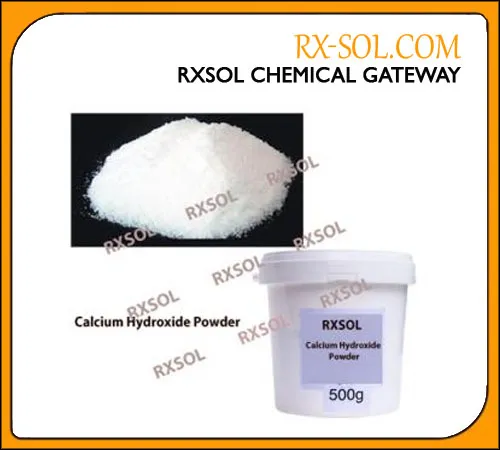
Overview
Technical specifications
CALCIUM OXIDE is an odorless, white or gray-white solid in the form of hard lumps. A strong irritant to skin, eyes and mucous membranes. Used in insecticides ...
| Appearance | White to pale yellow/brown powder |
| Odor | Odorless |
| Density | 3.34 g/cm3 |
| Melting point | 2,613 °C (4,735 °F; 2,886 K) |
| Boiling point | 2,850 °C (5,160 °F; 3,120 K) (100 hPa) |
|
Solubility in water
|
Reacts to form calcium hydroxide |
| Solubility in Methanol | Insoluble (also in diethyl ether, octanol) |
| Acidity (pKa) | 12.8 |
|
Magnetic susceptibility (χ)
|
−15.0×10⁻⁶ cm3/mol |
Applications
Pure Calcium oxide use in the rubber industry. Calcium OXIDE is use as a desiccant in rubber compounds
Calcium Oxide (CaO) for use as a desiccant in rubber compounds which are cured on micro-wave systems, LCM or hot air. Moisture which is present in all rubber chemicals, especially fillers, will be absorbed and the calcium oxide will change to calcium hydroxide after reaction with the moisture. This reaction will happen while storing the uncured rubber compounds.
Calcium Oxide as acid absorber. Working systems containing chlorine. By reaction of HCl (hydrochloric acid) with CaO, CaCl is formed. Therefore the corrosive effect of HCl on metal parts (e. g. vulcanization molds) can be diminished.
CALCIUM OXIDE. CaO. Calcium oxide is a white crystalline solid with a melting point of 2572̊C.
Dosage and directions
Calcium oxide (CaO), commonly known as quicklime or burnt lime, is a widely used chemical compound. It is a white, caustic, alkaline, crystalline solid at room temperature. The broadly used term "lime" connotes calcium-containing inorganic materials, in which carbonates, oxides and hydroxides of calcium, silicon, magnesium, aluminium, and iron predominate. By contrast, quicklime specifically applies to the single chemical compound calcium oxide. Calcium oxide that survives processing without reacting in building products such as cement is called free lime.
Characteristics and notes
- It is extensively used for medicinal purposes and insecticides.
- It finds its application in the manufacturing of cement, paper, and high-grade steel.
- Lime is used as a reagent in laboratories for dehydration, precipitation reaction, etc.
- It is the cheapest alkali available which is an important ingredient in the manufacturing of caustic soda.
- Calcium is essential to animal life as the constituent of bones, shells, and teeth. The most common of the calcium compounds are calcium carbonate which the potter uses as a source of calcium oxide for glazes.
Safety and SDS
Read the safety data sheet before handling. Wear suitable gloves and eye protection.
View safety data sheet
| Product Name | Calcium OXIDE Powder |
| Product Type | RXSOL-93-1495-025 |
Company Details:
RX MARINE INTERNATIONAL
105, A wing , BSEL , TECH PARK.
VASHI ,NEW BOMBAY 400703 INDIA
Stock Point : Mumbai, Kolkata, Chennai, Gandhidham, Visakhapatnam, Fujairah, Muscat
| Phone | +91 22 27815541 / 42 |
| Fax | +91 22 2781 1318 :::AOH :0091 9821214367 |
| rxsolchemicals@gmail.com |
|
Ingredient |
CAS No |
Percent |
Hazardous |
|
Calcium oxide |
1305-78-8 |
90 - 100% |
- |
Danger! Harmful if swallowed. Causes burns by all exposure routes. Reacts violently with water. Target Organs: Respiratory system, gastrointestinal system, eyes, skin.
Potential Health Effects
Eye: Causes eye burns.
Skin: Causes skin burns. May be harmful if absorbed through the skin.
Ingestion: Harmful if swallowed. Causes gastrointestinal tract burns.
Inhalation: Causes chemical burns to the respiratory tract. May be harmful if inhaled.
Chronic: Prolonged or repeated skin contact may cause dermatitis. Chronic inhalation may cause nasal septum ulceration and perforation.
|
Eyes |
Immediately flush eyes with plenty of water for at least 15 minutes, occasionally lifting the upper and lower eyelids. Get medical aid immediately |
|
Skin |
Get medical aid immediately. Immediately flush skin with plenty of water for at least 15 minutes while removing contaminated clothing and shoes. |
|
Ingestion: |
Do not induce vomiting. Get medical aid immediately. Call a poison control center. |
| Inhalation: | Get medical aid immediately. Remove from exposure and move to fresh air immediately. If breathing is difficult, give oxygen. Do not use mouth-to-mouth resuscitation if victim ingested or inhaled the substance; induce artificial respiration with the aid of a pocket mask equipped with a one-way valve or other proper |
| Notes to Physician: |
Treat symptomatically and supportively. |
General Information: As in any fire, wear a self-contained breathing apparatus in pressure-demand, MSHA/NIOSH (approved or equivalent), and full protective gear. Water reactive. Material will react with water and may release a flammable and/or toxic gas.
Extinguishing Media: Use foam, dry chemical, or carbon dioxide. DO NOT USE WATER!
Autoignition Temperature: Not available.
Flash Point: Not applicable.
Explosion Limits: Lower: Not available
Explosion Limits: Upper: Not available
NFPA Rating: ; Special Hazard: -W
General Information: Use proper personal protective equipment as indicated in Section 8.
Spills/Leaks: Vacuum or sweep up material and place into a suitable disposal container. Wear a self contained breathing apparatus and appropriate personal protection. (See Exposure Controls, Personal Protection section). Avoid generating dusty conditions. Provide ventilation. Do not expose spill to water. Do not get water inside containers. Do not let this chemical enter the environment.
|
Handling |
Do not allow water to get into the container because of violent reaction. Minimize dust generation and accumulation. Do not get in eyes, on skin, or on clothing. Do not ingest or inhale. Do not allow contact with water. Use only in a chemical fume hood. |
| Storage: |
Store in a cool, dry place. Store in a tightly closed container. Corrosives area. Store protected from moisture. Store under an inert atmosphere. |
+-------------------- +------------------- +------------------- +-------------------------- +
Chemical Name ACGIH NIOSH OSHA - Final PELs
-------------------- ------------------- --------------------- ---------------------------+
Calcium oxide 2 mg/m3 2 mg/m3 TWA 2 5 mg/m3 TWA
mg/m3 IDLH
+-------------------- +------------------- +------------------- +----------------- ------------+
OSHA Vacated PELs: Calcium oxide: 5 mg/m3 TWA (not in effect as a result of reconsideration)
Engineering Controls: Facilities storing or utilizing this material should be equipped with an eyewash facility and a safety shower. Use only under a chemical fume hood.
Exposure Limits Personal Protective Equipment
Eyes: Wear appropriate protective eyeglasses or chemical safety goggles as described by OSHA's eye and face protection regulations in 29 CFR 1910.133 or European Standard EN166.
Skin: Wear appropriate protective gloves to prevent skin exposure.
Clothing: Wear appropriate protective clothing to prevent skin exposure.
Respirators: Follow the OSHA respirator regulations found in 29 CFR 1910.134 or European Standard EN 149. Use a NIOSH/MSHA or European Standard EN 149 approved respirator if exposure limits are exceeded or if irritation or other symptoms are experienced.
Physical State: Powder
Color: white to light yellow - very slightly beige
Odor: Odorless.
pH: 12.5 (1.65 g/L aq sol)
Vapor Pressure: Negligible.
Vapor Density: Not available
Evaporation Rate: Negligible.
Viscosity: Not available
Boiling Point: 2850 deg C @ 760 mmHg ( 5,162.00F)
Freezing/Melting Point: 2570 deg C ( 4,658.00F)
Decomposition Temperature: Not available
Solubility in water: Reacts
Specific Gravity/Density: Not available.
Molecular Formula: CaO
Molecular Weight: 56.08
Chemical Stability: Air sensitive. Reacts violently with water. Moisture sensitive.
Conditions to Avoid: Incompatible materials, dust generation, exposure to air, exposure to moist air or water.
Incompatibilities with Other Materials Strong oxidizing agents, acids, carbon dioxide, chlorine trifluoride, fluorine, halogens, phosphorus pentoxide, calcium chloride, metal halides, hydrofluoric acid, hydrogen fluoride, ethanol, boron trifluoride.
Hazardous Decomposition Products Calcium hydroxide.
Hazardous Polymerization Has not been reported.
RTECS#: CAS# 1305-78-8: EW3100000
LD50/LC50: RTECS: Not available.
Carcinogenicity: Calcium oxide - Not listed as a carcinogen by ACGIH, IARC, NTP, or CA Prop 65.
Other: See actual entry in RTECS for complete information.
Dispose of in a manner consistent with federal, state, and local regulations.
Regional waste regulation : Disposal must be done according to official regulations.
Waste treatment methods : Dispose of contents/container in accordance with licensed collector’s sorting instructions. Sewage disposal recommendations : Disposal must be done according to official regulations.
Product/Packaging disposal recommendations : Dispose of contents/container to hazardous or special waste collection point, in accordance with local, regional, national and/or international regulation. Disposal must be done according to official regulations.
Additional information : Do not re-use empty containers.
US DOT
Shipping Name: CALCIUM OXIDE
Hazard Class: 8
UN Number: UN1910
Packing Group: III
Canada TDG Shipping Name: CALCIUM OXIDE
Hazard Class: 8
UN Number: UN1910
Packing Group: III
15.1. Safety, health and environmental regulations/legislation specific for the substance or mixture
15.1.1. EU-Regulations
REACH Annex XVII (Restriction List) : Not listed on REACH Annex XVII
REACH Annex XIV (Authorisation List) : Not listed on REACH Annex XIV (Authorisation List)
REACH Candidate List (SVHC) : Not listed on the REACH Candidate List
PIC Regulation (Prior Informed Consent) : Not listed on the PIC list (Regulation EU 649/2012)
POP Regulation (Persistent Organic Pollutants) : Not listed on the POP list (Regulation EU 2019/1021)
Ozone Regulation (1005/2009) : Not listed on the Ozone Depletion list (Regulation EU 1005/2009)
Dual-Use Regulation (428/2009) : Contains no substance subject to the COUNCIL REGULATION (EC) No 428/2009 of 5 May 2009 setting up a Community regime for the control of exports, transfer, brokering and transit of dual-use items.
Explosives Precursors Regulation (2019/1148) : Contains no substance(s) listed on the Explosives Precursors list (Regulation EU 2019/1148 on the marketing and use of explosives precursors)
Drug Precursors Regulation (273/2004) : Contains no substance(s) listed on the Drug Precursors list (Regulation EC 273/2004 on the manufacture and the placing on market of certain substances used in the illicit manufacture of narcotic drugs and psychotropic substances)
The information provided about the product on this Safety Data Sheet has been compiled from knowledge of the individual constituents.The data given here is based on current knowledge and experience. This Safety Data Sheet describes the product .in terms of safety requirements and does not signify any warranty with regard to the product's properties The data given here only applies when product used for proper application(s). The product is not sold as suitable for other applications - usage in such may cause risks not mentioned in this sheet. Do not use for other.
DISCLAIMER OF LIABILITY :The information in this SDS was obtained from sources which we believe are reliable. However, the information is provided without any warranty, express or implied, regarding its correctness. The conditions or methods of handling, storage, use or disposal of the product are beyond our control and may be beyond our knowledge. For this and other reasons, we do not assume responsibility and expressly disclaim liability for loss, damage or expense arising out of or in any way connected with the handling, storage, use or disposal of the product. This MSDS was prepared and is to be used only for this product. If the product is used as a component in another product, this MSDS information may not be applicable.
Availability
Calcium OXIDE Powder manufacturer supplier distributor in Mumbai, Kandla, Kolkata, Vizag, Chennai, India, Fujairah, Dubai, Sharjah, UAE, Gulf, Middle East, Muscat Oman, Kenya Africa. Get the best quality of Calcium OXIDE Powder at a competitive price from us. We have ready stock of Calcium OXIDE Powder in India, UAE Gulf, Oman, Kenya Africa. Contact us for bulk as well as small orders.
Frequently asked questions
What is calcium oxide used for in rubber?
As a moisture scavenger (desiccant) at 2–10 phr in continuous-vulcanisation compounds, and as an acid acceptor in CR, CSM and other halogenated rubbers.
Is quicklime hazardous?
Yes — it is a strong irritant to skin, eyes and lungs, and its reaction with water releases enough heat to ignite combustibles; keep dry and sealed.
Calcium oxide in Malayalam/Hindi?
കാൽസ്യം ഓക്സൈഡ് / कैल्शियम ऑक्साइड (चूना) — commonly "chuna" or quicklime.