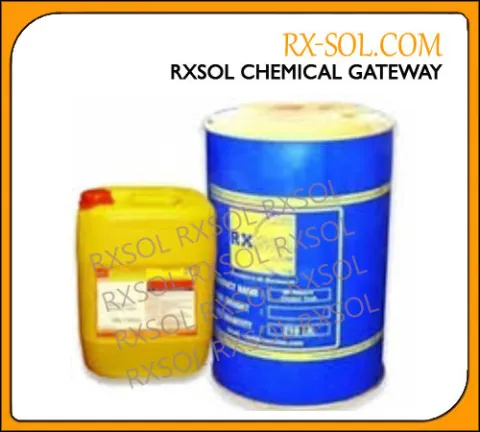

Fuel Emulsion Breaker 210 Ltr
- Part number
- RXSOL-70-7003-210
- IMPA code
- 551227, 553305.
- Active matter
- 83 - 88 %
- Category
- Engine room Maintenance
- Brand
- RXSOL
Overview
RXSOL-70-7003-210 rapidly breaks water-in-oil emulsions in all grades of fuel. It assists water removal in the settling tank and fuel centrifuges.will separate fuel oil and salt water emulsions from bunker tanks, industrial storage tanks, lube oil tanks,
Applications
Breaks water-in-oil emulsions by lowering the surface tension between the two phases. It is insoluble in water and remains effective even after the water has been removed. Powerful dispersants combat existing sludge formations while homogenizing the fuel to prevent new sludge from being formed.
Dosage and directions
1:1000-3000 ( 1 Ltr / 1-3 MT ) Dose into the bunker tank prior to, or during bunkring. Allow the product to mix well with the fuel .
Safety and SDS
Read the safety data sheet before handling. Wear suitable gloves and eye protection.
View safety data sheet
| Product Name | Fuel Emulsion Breaker |
| Part Number | RXSOL-70-7003-210 |
Company Details:
RX MARINE INTERNATIONAL
105, A wing , BSEL , TECH PARK.
VASHI ,NEW BOMBAY 400703 INDIA
Branch : Kandla, Mumbai , Chennai, Vizag, Kolkata, UAE , OMAN , CANADA and KENYA
| Phone | +91 22 20871200 - 1400 |
| Fax | +91 22 27612100 :::AOH :0091 9821214367 |
| rxsolchemicals@gmail.com | |
| Website | www.rxmraine.com |
| Chemical Name | CAS No | EC Number | Symbols | Concentration |
| Naphtha (petroleum), Hydrodesulfurized heavy | 64742-82-1 | 265-185-4 | Xn | 60-81 |
| Proprietory Blend | --- | --- | --- | 21-30 |
| Classification of the substance or mixture |
Counsil Directive 1999/45/EEC Classification, packing and labelling of dangerous preparations.
Refer to The Dangerous Substances Directive (67/548/EEC).
Regulations 1272/2008/EEC. Classification, labeling and packing of dangerous substances and preparations.
|
| Label elements |
Contains:Naphta (petroleum) hydrodesulfurized heavy. Harmful: may cause lung damage if swallowed (R65).
Repeated exposure may cause skin dryness or cracking (R66).
|
| Hazards identification |
Do not breathe vapour/fumes (S23).
Do not breathe spray/mists (S23).
Wear suitable protective clothing, eye/face protection and gloves (S36/37/39).
If swallowed, do not induce vomiting: seek medical advice immediately and show this container or label (S62).
|
| Other hazards |
Odour: Smells of hydrocarbon
Appearance: Liquid, light, yellow, insoluble in water.
Contact with eyes: Causes redness and irritation.
Inhalation: In cases of severe exposure, nausea/vomiting may develop.
In cases of severe exposure, dizziness, confusion, headache or stupor may develop.
|
| General advice | Consult a physician. Show this safety data sheet to the doctor in attendance. Move out of dangerous area. |
| If inhaled |
IF INHALED: If breathing is difficult, remove to fresh air and keep at rest in a position comfortable for breathing.
|
| Eye Contact |
IF IN EYES: Rinse cautiously with water for several minutes. Remove contact lenses, if present and easy to do. Continue rinsing.
Irrigate eyes thoroughly whilst lifting eyelids.
When in doubt or symptoms persist, seek medical attention.
|
| Swallowed |
IF SWALLOWED: rinse mouth. Do NOT induce vomiting.
Do not induce vomiting because of risk of aspiration into the lungs. If aspiration is suspected obtain immediate medical attention.
If vomiting occurs turn patient on side. Obtain immediate medical attention
|
| Skin Contact |
IF ON SKIN (or hair): Remove/Take off immediately all contaminated clothing. Rinse skin with water/shower. Contaminated clothing should be laundered before reuse. Seek medical attention if irritation persists.
|
| Most important symptoms and effects, both acute and delayed |
In cases of severe exposure, dizziness, confusion, headache or stupor may develop.
Vapours or aerosols may cause irritation of eyes, nose and respiratory tract.
|
| Indication of any immediate medical attention and special treatment needed | No data available. |
| Suitable extinguishing media |
In case of fire use water spray or fog, alcohol resistant foam, dry chemical or carbon dioxide (S43).
Do not use water jets.
|
| Special hazards arising from the substance or mixture |
Vapours are heavier than air and may travel considerable distances to a source of ignition and flashback.
Smoke from fires is toxic. Take precautions to protect personnel from exposure.
|
| Advice for firefighters |
Vapours are heavier than air and may travel considerable distances to a source of ignition and flashback.
Smoke from fires is toxic. Take precautions to protect personnel from exposure.
Wear Breathing Apparatus.
Prevent run off water from entering drains if possible.
|
| Personal precautions, protective equipment and emergency procedures | Wear protective clothing as per section 8. |
| Enviromental Precaution | Avoid release to the environment. |
| Methods and materials for containment and cleaning |
Absorb spillage in inert material and shovel up. Ventilate the area and wash spill site after material pick-up is complete.
|
| Reference to other sections | None. |
| Precautions for safe handling |
Eyewash bottles should be available. Do not get in eyes, on skin, or on clothing.
|
| Conditions for safe storage, including any incompatibilities |
Keep only in the original container in a cool, well ventilated place (S3/9/49).
Keep container tightly closed (S7).
Keep away from open flames, hot surfaces and sources of ignition.
|
| Control parameters |
Naphtha (petroleum), hydrodesulfurized heavy TLV (TWA) 275 mg/m3.
|
| Exposure control | No special ventilation is required unless the product is used in a spray form. |
| Occupational Exposure controls |
No respiratory protection is required unless subject to contact with substance mist. During fumigation/spraying
wear suitable respiratory equipment (S42).
Wear suitable respiratory protection. Gas cartridge (organic substances).
Wear suitable protective clothing, including eye/face protection and gloves (neoprene or nitrile are recommended).
|
| Physical state | Liquid, light yellow, insoluble in water. |
| Odour | Smells of hydrocarbon. |
| Odor Threshold | Not Applicable |
| pH | No data available |
| Melting Point | No data available |
| Boiling Point | 175 °C to 215 °C at 760 mm /Hg |
| Flash Point | >62 deg C (CC) |
| Evaporation Rate | No data available |
| Flammability (solid, gas) | No data available |
| Explosive limits | No Data Available |
| Upper/lower flammability or explosive limits |
Lower explosive limit 0.6 % (in air) Upper explosive limit 7 % (in air) |
| Autoignition temperature | >200 deg C |
| Decomposition temperature | No data available |
| Vapour pressure | No data available |
| Density | 0.82 g/cm3 at 20 deg C |
| Vapour Density | No Data Available |
| Freezing point | No data available |
| Specific Gravity | 0.84 - 0.89 |
| Partition coefficient | No data available |
| Explosive properties | No data available |
| Solubility | Insoluble in water |
| Relative density | 0.893 g/cm3 @ 25o C (77o F) |
| Ignition temperature | No information available. |
| Particle characteristics | No data available |
| Viscosity | No data available |
| Reactivity | This article is considered stable under normal conditions |
| Stability | This article is considered stable under normal conditions. |
| Possibility of hazardous reactions | No hazardous reactions known if used for its intended purpose. |
| Conditions to avoid | Keep away from naked flames, incandescent or hot surface. |
| Incompatible materials | None. |
| Hazardous decomposition products |
Decomposition products may include carbon oxides, carbon dioxide.
|
| Acute toxicity | No experimental data available. |
| Contact with skin |
Prolonged skin contact will result in defatting of the skin, leading to irritation, and in some cases, dermatitis.
|
| Contact with eyes | Causes irritation. |
| Inhalation | Inhalation of solvent vapours may give rise to nausea, headaches and dizziness. |
| Ingestion |
The ingestion of significant quantities may cause damage to lungs. May cause gastro-intestinal disturbances.
|
| Carcinogenicity | No evidence of carcinogenic effects. |
| Toxicity | LC50 (fish) (naphta) 10-100 mg/l (96 hr). |
| Persistence and degradability | Most components in this product are not readily biodegradable. |
| Bioaccumulative potential | Hydrocarbon solvents have the potential to bioaccumilate. |
| Mobility in soil | Insoluble in water. |
| Results of PBT and vPvB assessment | Not a PBT according to REACH Annex XIII. |
| Other Adverse Effects |
No environmental problems are expected when the product is used / handled correctly. In its intended use, the product will not be released into the environment.
|
| Waste treatment methods |
Do not discharge into drains or the environment, dispose to an authorised waste collection point. Disposal should be in accordance with local, state or national legislation
|
| Classification |
EU Waste class: 07.01.99. This material and/or its container must be disposed of as hazardous waste
|
| UN number | N/A |
| UN proper shipping name |
N/A |
| Transport hazard class(es) | N/A |
| Packaging group | N/A |
| Environmental hazards | On available data, substance is not harmful to the environment |
| Safety, health and environmental regulations specific for the product in question |
This Safety Data Sheet has been prepared in accordance with article 31 and annex II in REACH and Directive 453/2010/EU.
|
| Chemical Safety Assessment | None |
| Other Information |
The information above is believed to be accurate and represents the best information currently available to us. However, we make no warranty of merchant ability or any other warranty, express or implied, with respect to such information, and we assume no liability resulting from its use. Users should make their own investigations to determine the suitability of the information for their particular purposes. In no event shall be liable for any claims, losses, or damages of any third party or for lost profits or any special, indirect, incidental, consequential or exemplary damages, how so ever arising, even if RX Marine International has been advised of the possibility of such damages. DISCLAIMER OF LIABILITY :The information in this SDS was obtained from sources which we believe are reliable. However, the information is provided without any warranty, express or implied, regarding its correctness. The conditions or methods of handling, storage, use or disposal of the product are beyond our control and may be beyond our knowledge. For this and other reasons, we do not assume responsibility and expressly disclaim liability for loss, damage or expense arising out of or in any way connected with the handling, storage, use or disposal of the product. This MSDS was prepared and is to be used only for this product. If the product is used as a component in another product, this MSDS information may not be applicable. |
Technical bulletin
Open technical bulletin
Fuel Care (RXSOL-70-7003-210)
Rxsol fuel oil Conditioner
Product Introduction: RXSOL-70-7003-210 is based on a combustion accelerator & fuel conditioning properties for heavy marine fuel oils.RXSOL-70-7003-210 is a balanced blend of dispersing agents , surfactants and catalyst of combustion improver with Emulsion Breaker.Acidic components present in fuels are neutralized with FEB 7003 , which prevents corrosion of components.
Product Properties: RXSOL-70-7003-210 functions via a unique dual mechanism.The catalyst of combustion improver reduced the ignition temperature by which fuel combustion efficiency increases & minimizes the free carbon formati- on during combustion which results the minimization of smoke ,soot ,& other intermediate by products While other hands dispersing and polymerizing agents inhibit sludge formation which improves the fuel flow.By catalytically reaction RXSOL-70-7003-210 stop the formation of acid gases. This reduces the amount of acid present, thereby reducing acid corrosion.
Application , Doses & Control Rates: RXSOL-70-7003-210 may be fed directly from the drum ,using a metering pump or other feeding device, or it can be added into the settling tank directly.RXSOL-70-7003 may be added to bunker tank via sounding pipe prior to bunkering or it may be introduced into the settling tank during transfer from double bottom or deep tanks. Depends on fuel analysis for Micro Carbon Residue ,average dosage rates are one Lts RXSOL-70-7003-210 require for 1000 to 4000 Lts of fuel.This may be extend upto 1 Ltr to 6000 Ltrs of fuel once condition have stablised.
Safety And Handling: Avoid contact with eye and naked skin, In case of contact flush with plenty of water.
Characteristics:
| Appearance | Clear liquid |
| Colour | Dark brown |
| Density | In g/cm3 at 15°C: 0.79 ±0.02 |
| Flash point | (PMCC)°C: Above 0 |
| Active Matter | 100% 258°C |
| Miscibility IN Solvent | Completely fuel oil soluble |
Compatibility:
| Chemical | Good with oxidizing And reducing agent | |
| Metal | No known effect | |
| Rubber | May swell | |
| Synthetic rubber | May swell | |
| Packaging | Order no. | Size (in liters) |
| RXSOL-70-7003-210 | 25 /210 |
Characteristics :
- By reducing ignition temperature Improves combustion.
- Maintains a protection towards metals by catalytic effects
- Minimizes corrosion and sludge formation
- Non-corrosive.
- Effectively reduces the soot / free carbons formation.
- Concentrated product for economy of use.
Availability
Fuel Emulsion Breaker manufacturer supplier distributor in Mumbai, Kandla, Kolkata, Vizag, Chennai, India, Fujairah, Dubai UAE, Muscat Oman, Kenya Africa. Get the best quality of Fuel Emulsion Breaker at a competitive price from us. We have ready stock of Fuel Emulsion Breaker in India, UAE Gulf, Oman, Kenya Africa. Contact us for bulk as well as small orders.