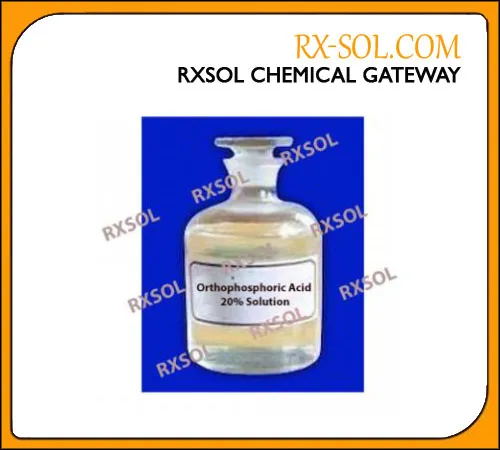
Orthophosphoric Acid 20% Solution
- Part number
- RXSOL-60-6219-500
- Category
- Lab Chemical
- Brand
- RXSOL
Overview
Phosphoric acid is a component of fertilizers (80% of total use), detergents, and many household cleaning products. Dilute solutions have a pleasing acid taste; thus, it's also used as a food additive, lending acidic properties to soft drinks and other prepared foods, and in water treatment products.
Applications
Phosphoric acid (PA) is an important industrial acid that is utilized for manufacturing phosphatic fertilizers and industrial products, for pickling and posterior treatment of steel surfaces to prevent corrosion, for ensuring appropriate paint adhesion, and for the food and beverages industry, e.g. cola-type drinks to
Safety and SDS
Read the safety data sheet before handling. Wear suitable gloves and eye protection.
View safety data sheet
| Product Name | Orthophosphoric Acid 20% Solution |
| Product Type | RXSOL-60-6219-500 |
Company Details:
RX MARINE INTERNATIONAL
105, A wing , BSEL , TECH PARK.
VASHI ,NEW BOMBAY 400703 INDIA
| Phone | +91 22 65113333 / 5555 / 9999 |
| Fax | +91 22 2781 1318 :::AOH :0091 9821214367 |
| rxsolchemicals@gmail.com |
| SARA 313 Component | CAS Number | Percent Comp. |
Dimension |
Exposure Limits |
| Phosphoric Acid 85% w/w | CAS# 7664-38-2 |
12- |
V/V | TWA 1 mg/mƒSTEL |
| Water, Deionized ASTM Type II | CAS# 7732-18-5 | 88% | V/V | None Established |
Causes severe irritation and burns. May Be harmful if swallowed. Avoid breathing vapor or dust. Use with adequate ventilation. Avoid contact with eyes, skin, and clothes. Wash thoroughly after handling. Keep
container closed.
Emergency Overview:Danger! Corrosive. Causes Severe Irritation And Burns To Every Area Of Contact. Harmful If Swallowed Or Inhaled.
Inhalation:Inhalation is not an Expected Hazard Unless Misted or Heated to High Temperatures.Mist or Vapor Inhalation can Cause Irritation to the Nose, Throat, and Upper Respiratory Tract.Severe Exposures can Lead to a Chemical Pneumonitis.
Ingestion:Corrosive! May Cause Sore Throat, Abdominal Pain, Nausea, and Severe Burns of the Mouth, Throat, and Stomach. Severe Exposures can Lead to Shock, Circulatory Collapse, and Death.
Skin:Corrosive! Can cause Redness, Pain, and Severe Skin Burns.
Eye Contact:Corrosive! May Cause Redness, Pain, Blurred Vision, Eye Burns, and Permanent Eye Damage.
Chronic Exposure:No Information Found.
Aggravated by Exposure:Persons with Pre-Existing skin Disorders or Eye Problems, or Impaired Respiratory Function may be More Susceptible to the Effects of the Substance.
Causes severe irritation and burns. May Be harmful if swallowed. Avoid breathing vapor or dust. Use with adequate ventilation. Avoid contact with eyes, skin, and clothes.Wash thoroughly after handling. Keep container closed.
|
SKIN: |
Remove contaminated clothing. Wash exposed area with soap and water. if irritation persists, seek medical attention. |
| EYES: | Wash eyes with plenty of water for at least 15 minutes, lifting lids occasionally.Seek Medical Aid. INHALATION: Remove to fresh air. If not breathing, give artificial respiration. If breathing is difficult, give oxygen |
| INGESTION: | Give several glasses of milk or water. Vomiting may occur spontaneously, but DO NOT INDUCE! Never give anything by mouth to an unconscious person. |
|
Fire Extinguisher Type: |
Water spray, dry chemical, carbon dioxide, alcohol foam |
| Fire / Explosion Hazards: | Thermal decomposition produces highly toxic fumes. |
| Fire Fighting Procedure: | Wear self-contained breathing apparatus and protective clothing to prevent contact with skin and clothing. |
Absorb spill with inert material, then place in a chemical waste container. Dispose of in a manner consistent with federal, local law.
Ventilate area of Leak or Spill. Wear Appropriate Personal Protective Equipment as Specified in Section 8. Isolate Hazard Area. Keep Unnecessary and Unprotected Personnel from Entering. Contain and Recover Liquid when Possible. Neutralize with Alkaline Material (Soda-Ash, Lime), then Absorb with an Inert Material (e.g., Vermiculite,Dry Sand, Earth), and place in a Chemical Waste Container. Do Not Use Combustible Materials,such as Saw Dust. Do Not Flush to Sewer! US Regulations(CERCLA) Require Reporting Spills and Releases to Soil,Water and Air in Excess of Reportable Quantities.
Store in a cool dry well ventilated area. Keep away from heat and flame. Do not get in eyes, on skin, or on clothing.
|
Respiratory Protection |
None required |
| Ventilation | Local |
| OTHER | Mechanical |
| Protective Gloves | Wear appropriate gloves to prevent skin exposure |
| EYE PROTECTION | Splash Goggles |
| Other Protective Equipment | Wear appropriate clothing to prevent skin exposure |
| BOILING POINT | 128 Deg C |
| VAPOR PRESSURE | information not available |
| MELTING POINT | 21 Deg C |
| VAPOR DENSITY | 128 Deg C |
| EVAPORATION RATE | information not available |
| Appearance /Odors | Colorless Syrupy liquid odorless liquid |
| Flash Point |
Not applicable |
| Specific Gravity | 1.69 |
| Percent Volatile by | 100% @ 21 Deg C |
| Evaporation Standard | |
| Auto Ignition Temp |
Not applicable |
| Lower Flamm. Limit in Air | Not applicable |
| Upper Flamm. Limit in Air | Not applicable |
| Solubility in Water |
Miscible Lower Flamm. Limit in Air Information not proportions of available water |
|
STABILITY |
Stable |
|
CONDITIONS TO AVOID |
Avoid contact with incompatible materials. |
|
MATERIALS TO AVOID |
Metals, bases Hazardous Decomposition Oxides of phosphorus |
|
HAZARDOUS DECOMPOSITION PRODUCTS |
Oxides of phosphorus |
|
HAZARDOUS POLYMERIZATION |
will not occur |
| Conditions to Avoid | None known |
Hydrogen Chloride - IARC Category 3, NTP Carcinogen - Known: No
Environmental Fate:When Released into the Soil, This Material may Leach into Groundwater.When Released to Water, Acidity may be Readily Reduced by Natural Water Hardness Minerals.
Whatever cannot be saved for recovery or recycling should be handled as hazardous waste and sent to a RCRA approved incinerator or disposed in a RCRA approved waste facility.Processing, use or contamination of this product may change the waste management options.State and local disposal regulations may differ from federal disposal regulations. Dispose of container and unused contents in accordance with federal, state and local requirements..
DOT Classification: UN1805,Phosphoric Acid, 8, PG III
DOT Regulations may change from time to time. Please consult the most recent D.O.T. regulations.
Chemical Inventory Status –
Part 1:Ingrdient TSCA EC Japan Australia
Phosphoric Acid (7664-38-2) Yes Yes Yes Yes
Chemical Inventory Status –
Part 2:Ingredient Korea DSL NDSL Phil.
Phosphoric Acid (7664-38-2) Yes Yes No Yes
Federal, State & International Regulations –
Part 1: Ingredient RQ TPQ List Chem Catg.
Phosphoric Acid (7664-38-2)NO NO NO NO
Federal, State &
International Regulations –
Part 2:Ingredient CERCLA 261.33 8(d)
Phosphoric Acid (7664-38-2) 5000 No
TSCA 12 (b):No CDTA:No
Acute: NO
Chronic: NO
Fire: NO
Pressure: No
Reactivity: No
SARA 311/312: PURE/Liquid)
Australian Hazchem 2R
Poison Schedule:S5
Corrosive! Conditions aggravated/target organs: Persons with preexisting skin, eye or respiratory conditions may be more susceptible. Acute: Severe irritation or burns to skin, eyes, mucous membranes, respiratory and GI tracts. Chronic: Dermatitis, damage to eyes, lungs, mucous membranes.
Flammability
Health Reactivity
|
Revisions |
NFPA |
| 7/26/2010 | 0.1 updated msds to 16 section from 10 section msds. STN |
| 0 |
The information herein is believed to be accurate and is offered in good faith for the user's consideration and investigation. No warranty either expressed or implied is made for the completeness or accuracy of the information whether originating from the above mentioned company or not. Users of this material should satisfy themselves by independent investigation of current scientific and medical knowledge that the material
DISCLAIMER OF LIABILITY :The information in this SDS was obtained from sources which we believe are reliable. However, the information is provided without any warranty, express or implied, regarding its correctness. The conditions or methods of handling, storage, use or disposal of the product are beyond our control and may be beyond our knowledge. For this and other reasons, we do not assume responsibility and expressly disclaim liability for loss, damage or expense arising out of or in any way connected with the handling, storage, use or disposal of the product. This MSDS was prepared and is to be used only for this product. If the product is used as a component in another product, this MSDS information may not be applicable.