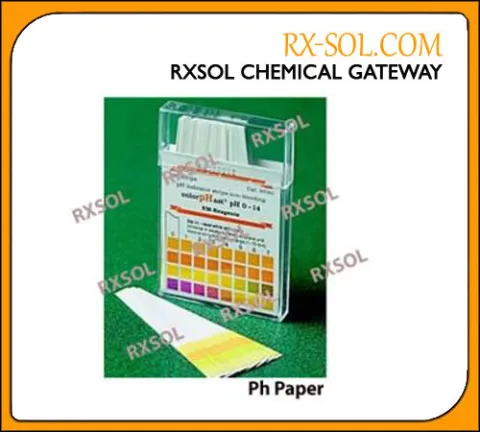
STARCH IODIDE PAPER
- Part number
- RXSOL-60-6605-607
- Category
- Lab Chemical
- Brand
- RXSOL
Overview
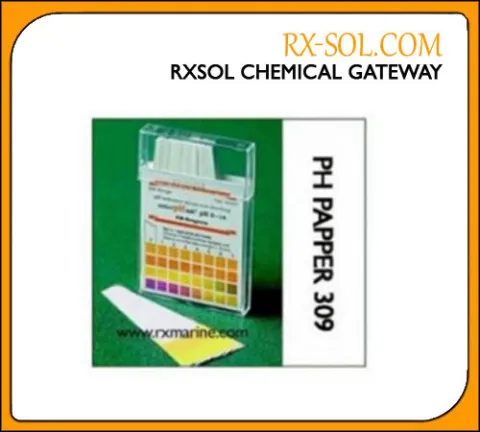
Hint Starch iodide paper consists of potassium iodide and starch. It is used for detection of nitrite and free chlorine atoms. Free chlorine and nitrite ion readily accept an electron to gain their stable configuration. As they get reduced, they end up oxidizing the iodide ion present in the form of potassium iodide.
Applications
The Potassium Iodide Starch test paper contains potassium iodide as an active ingredient. In the presence of an oxidant, such as peroxide or chlorine, iodide is converted to iodine which then binds to starch molecules in the paper forming the blue to purple color.
Dosage and directions
Chlorine turns moist starch iodide paper blue-black because the iodide ions on the paper are oxidised to iodine and the starch react to it to give blue black compound.
Characteristics and notes
When moist starch iodide paper is introduced into chlorine gas, chlorine oxidizes iodide to iodine, which shows up as blue when complexed with starch.
Safety and SDS
Read the safety data sheet before handling. Wear suitable gloves and eye protection.
View safety data sheet
| Product Name | : STARCH IODIDE PAPER |
| Part Number | : RXSOL-60-6605-607 |
Company Details:
RX MARINE INTERNATIONAL
105, A wing , BSEL , TECH PARK.
VASHI ,NEW BOMBAY 400703 INDIA
Branch : Kandla, Sikka, Dahej, Hazira, JNPT, Goa, Mangalore, Cochin, Tuticorin, Chennai, Kakinada, Vizag, Paradip, Kolkata, UAE, Singapore.
| Phone | +91 22 27815540 / 41 / 42 |
| Fax | +91 22 2781 1318 :::AOH :0091 9821214367 |
| rxsolchemicals@gmail.com | |
| Website | www.rxmarine.com |
| Name of Substance | Cas Number | EINECS No | Wt.% | Symbol |
| Ammonium Bisulphite | 10192-30-0 | 203-469-7 | 10 -30 % | Xi |
| Ethanediol | 107-21-1 | 203-473-3 | 10 - 30% | Xn |
| Quaternary Ammonium Chloride | 68391-01-5 | 269-919-4 | 10 - 30% | C |
| Propan-2-ol | 67-63-0 | 200-661-7 | 1 - 5 % | Xi |
| Classification of the substance or mixture | Not a hazardous substance or mixture according to Regulation (EC) No 1272/2008. |
| Label elements |
No hazard pictogram, no signal word, no hazard statement(s), no precautionary
statement(s) required
|
| Other hazards |
..This substance/mixture contains no components considered to be either persistent,
bioaccumulative and toxic (PBT), or very persistent and very bioaccumulative (vPvB) at
levels of 0.1% or higher.
|
| Mixtures | No components need to be disclosed according to the applicable regulations. |
| If inhaled |
After inhalation: fresh air.
|
|
In case of skin contact
|
After skin contact: wash off with plenty of water. Remove contaminated clothing |
| In case of eye contact | After eye contact: rinse out with plenty of water |
| If swallowed |
After swallowing: make victim drink water (two glasses at most). Consult doctor if feeling
unwell.
|
| Most important symptoms and effects, both acute and delayed |
The most important known symptoms and effects are described in the labelling (see section
2.2) and/or in section 11
|
| Indication of any immediate medical attention and special treatment needed | No data available |
General information: Extinguishing materials should be selected according to the surrounding area. The product itself is not combustible.
| Suitable extinguishing media | Water Carbon dioxide (CO2) Foam Dry powder |
| Unsuitable extinguishing media | For this substance/mixture no limitations of extinguishing agents are given. |
| Special hazards arising from the substance or mixture |
Nature of decomposition products not known.
Combustible.
Development of hazardous combustion gases or vapours possible in the event of fire.
|
| Advice for firefighters | In the event of fire, wear self-contained breathing apparatus. |
| Further information |
Suppress (knock down) gases/vapors/mists with a water spray jet. Prevent fire
extinguishing water from contaminating surface water or the ground water system.
|
| Personal precautions, protective equipment and emergency procedures |
Advice for non-emergency personnel: Evacuate the danger area, observe emergency
procedures, consult an expert.Advice for emergency responders:
For personal protection see section 8.
|
| Enviromental Precaution | Do not let product enter drains. |
|
Methods and materials for containment and cleaning up |
Collect. Dispose of properly. |
| Reference to other sections | For disposal see section 13. |
| Advice on safe handling | Observe label precautions. |
| Hygiene measures |
Change contaminated clothing. Wash hands after working with substance.
For precautions see section 2.2.
|
| Storage conditions |
Tightly closed. Dry.
Recommended storage temperature see product label.
|
| Storage class | Storage class (TRGS 510): 11: Combustible Solids |
|
Specific end use(s)
|
Apart from the uses mentioned in section 1.2 no other specific uses are stipulated |
| Personal protective equipment |
Eye/face: protection Safety glasses. Skin protection : not required
Respiratory protection :not required .Control of environmental exposure ;Do not let product enter drains.
|
| Control parameters | Ingredients with workplace control parameters |
Gloves Suit
| Physical state | solid |
| Colour |
white
|
| Odour | odorless |
|
Melting
point/freezing point
|
No data available |
|
Initial boiling point
and boiling range
|
No data available |
|
Upper/lower
flammability or
explosive limits
|
No Data Available |
| Flash point | No data available |
|
Autoignition
temperature
|
No data available |
|
Decomposition
temperature
|
No data available |
| pH | No data available |
| Viscosity |
Viscosity, kinematic: No data available
Viscosity, dynamic: No data available
|
| Explosive properties | No data available |
| Water solubility | No data available |
|
Partition coefficient:
n-octanol/water
|
No data available |
| Vapor pressure | No data available |
|
Density No data available
Relative density
|
No data available |
|
Relative vapor
density
|
No data available |
|
Particle
characteristics
|
No data available |
| Explosive properties | Not classified as explosive. |
| Oxidizing properties | none |
| Other safety information | No data available |
| Recativity | No data available |
| Chemical stability | Stable under recommended storage conditions. |
| Possibility of hazardous reactions | No data available |
|
Conditions to avoid
|
No data available |
| Incompatible materials |
No data available |
| Hazardous decomposition products | In the event of fire: see section 5 |
| Acute toxicity |
Oral: No data available
Inhalation: No data available
Dermal: No data available
|
| Skin corrosion/irritation |
No data available |
| Serious eye damage/eye irritation | No data available |
| Respiratory or skin sensitization | No data available |
|
Germ cell mutagenicity
|
No data available
|
|
Carcinogenicity
|
No data available |
| Reproductive toxicity | No data available |
|
Specific target organ toxicity - single exposure
|
No data available |
| Specific target organ toxicity - repeated exposure | No data available |
| Aspiration hazard | No data available |
|
Endocrine disrupting properties
Product:
|
Assessment : The substance/mixture does not contain
components considered to have endocrine
disrupting properties according to REACH Article
57(f) or Commission Delegated regulation (EU)
2017/2100 or Commission Regulation (EU)
2018/605 at levels of 0.1% or higher.
Hazardous properties cannot be excluded but are unlikely when the product is handled
appropriately.Handle in accordance with good industrial hygiene and safety practice.
|
|
Toxicity
Mixture
|
No data available |
| Persistence and degradability | No data available |
| Bioaccumulative potential | No data available |
| Mobility in soil | No data available |
| Biodegradability | No data available |
| Results of PBT and vPvB assessment |
This substance/mixture contains no components considered to be either persistent,
bioaccumulative and toxic (PBT), or very persistent and very bioaccumulative (vPvB) at
levels of 0.1% or higher.
|
|
Endocrine disrupting properties
Product:
|
Assessment : The substance/mixture does not contain components considered to have endocrine disrupting properties according to REACH Article 57(f) or Commission Delegated regulation (EU) 2017/2100 or Commission Regulation (EU) 2018/605 at levels of 0.1% or higher. |
|
Other adverse effects
|
No data available |
|
Waste treatment methods
Product
|
See www.retrologistik.com for processes regarding the return of chemicals and
containers, or contact us there if you have further questions.
|
Hazard Pictograms:
| UN Number | ADR/RID: - IMDG: - IATA: - |
| UN proper shipping name |
ADR/RID: Not dangerous goods
IMDG: Not dangerous goods
IATA: Not dangerous goods
|
| Transport hazard class(es) | |
| ADR/RID | 8ADR/RID: - IMDG: - IATA: - |
| Packing group | III ADR/RID: - IMDG: - IATA: |
| Environmental hazards |
ADR/RID: no IMDG Marine pollutant: no IATA: no
|
| Further information | Not classified as dangerous in the meaning of transport regulations. |
|
Safety, health and environmental regulations/legislation specific for the
substance or mixture
|
This material safety data sheet complies with the requirements of Regulation (EC) No.
1907/2006.
|
| Chemical safety assessment | For this product a chemical safety assessment was not carried out |
| Other Information |
The information above is believed to be accurate and represents the best information currently available to us. However, we make no warranty of merchantability or any other warranty, express or implied, with respect to such information, and we assume no liability resulting from its use. Users should make their own investigations to determine the suitability of the information for their particular purposes. In no event shall be liable for any claims, losses, or damages of any third party or for lost profits or any special, indirect, incidental, consequential or exemplary damages, howsoever arising, even if Rx Marine International has been advised of the possibility of such damages. DISCLAIMER OF LIABILITY :The information in this SDS was obtained from sources which we believe are reliable. However, the information is provided without any warranty, express or implied, regarding its correctness. The conditions or methods of handling, storage, use or disposal of the product are beyond our control and may be beyond our knowledge. For this and other reasons, we do not assume responsibility and expressly disclaim liability for loss, damage or expense arising out of or in any way connected with the handling, storage, use or disposal of the product. This MSDS was prepared and is to be used only for this product. If the product is used as a component in another product, this MSDS information may not be applicable. |
Availability
Frequently asked questions
How is moist starch iodide paper used for chlorine?
Wet the strip with distilled water and hold it in the gas or dip it in the sample; chlorine turns it blue-black within seconds.
Does it show how much chlorine is present?
No — it is a presence/absence test; use the DPD chlorine test kit (0–25 ppm) for a reading.
Shelf life?
2–3 years sealed and dry, away from light and fumes.