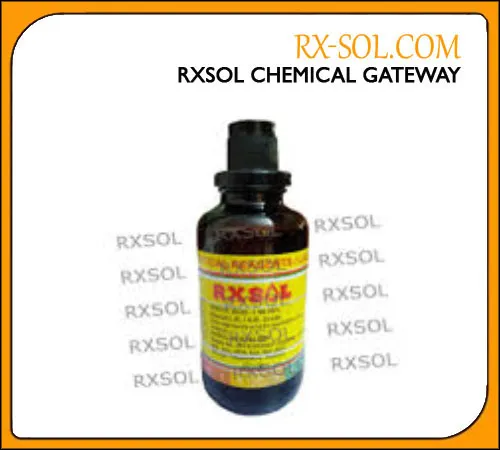
Thymolphthalein Indicator Solution
- Part number
- RXSOL-61-6293-100
- Category
- Lab Equipment
- Brand
- RXSOL
Safety and SDS
Read the safety data sheet before handling. Wear suitable gloves and eye protection.
View safety data sheet
| Product Name | RXSOL-61-6293-100 |
| Product Type | Thymolphthalein Indicator Solution |
Company Details:
RX MARINE INTERNATIONAL
105, A wing , BSEL , TECH PARK.
VASHI ,NEW BOMBAY 400703 INDIA
| Phone | +91 22 65113333 / 5555 / 9999 |
| Fax | +91 22 2781 1318 :::AOH :0091 9821214367 |
| rxsolchemicals@gmail.com |
| SARA 313 Component | CAS Number | Percent Comp. |
Dimension |
Exposure Limits |
|
1,2-Propanediol (Propylene Glycol) |
CAS# 57-55-6 | 33.3% |
V/V |
|
| N-Propoxy Propanol Prop Glycol Propyl Ether | CAS#1569- | 33.3% | V/V |
OSHA TWA 1000 ppm (2400 mg/mƒ) |
| Thymolphthalein | CAS# 125-20-2 | 0.1% | W/V |
None Established |
| Water, Deionized ASTM Type II | CAS# 7732-18-5 | 33.3% | V/V |
None Established |
Keep away from heat and ignition sources. Harmful if swallowed. Avoid breathing vapors. Use with adequate ventilation. Avoid contact with eyes, skin, and clothes. Wash thoroughly after handling. Keep container
Emergency Overview:Caution! May Be Harmful If Swallowed, Inhaled Or Absorbed Through Skin. May Cause Irritation To Skin, Eyes, And Respiratory Tract.
Inhalation:Overexposure may Cause Coughing, Shortness of Breath Dizziness, Intoxication and Collapse.
Ingestion:May Cause Moderate Irritation of the Mouth, Throat, Esophagus and Stomach, with Abdominal and Chest Discomfort.
Skin:Exposure to this Material can Result in Absorption Through Skin Causing a Significant Health Hazard.
Eye Contact:Liquid Vapor, and Mist May Cause Discomfort in the Eye with Persistent Conjunctivitis, Seen as
Slight Excess Redness of Conjunctiva. Serious Corneal Injury in Not Anticipated.
Chronic Exposure:Repeated or Prolonged Skin Contact may Cause Progressive Dermatitis and may Aggravate Pre-Existing Dermatitis. Repeated or Prolonged Exposure to Vapors may Aggravate Asthma and
Other Respiratory Conditions. Overexposure may Cause Incooridination of Movements, Speech Difficulties, Headache, Loss of Conciousness and Possible Liver and Kidney Damage.
Aggravated by Exposure:This Material or its Emissions may Affect the Central Nervous System (CNS) and/or Aggravate Pre-Existing CNS Disorders. Prolonged Observation may be Indicated.
Keep away from heat and ignition sources. Harmful if swallowed. Avoid breathing vapors. Use with adequate ventilation. Avoid contact with eyes, skin, and clothes. Wash thoroughly after handling. Keep container closed.
|
SKIN: |
Wash exposed area with soap and water. If irritation persists, seek medical attention. |
| EYES: |
Wash eyes with plenty of water for at least 15 minutes, lifting lids occasionally. Seek Medical Aid. |
|
INHALATION: |
Remove to fresh air. If not breathing, give artificial respiration. If breathing is difficult, give oxygen |
|
INGESTION: |
Give several glasses of milk or water. Vomiting may occur spontaneously, but DO NOT INDUCE! Never give anything by mouth to an unconscious person. |
| Fire Extinguisher Type: |
Any means suitable for extinguishing surrounding fire |
| Fire / Explosion Hazards: | material may burn in a fire. |
| Fire Fighting Procedure: | Wear self-contained breathing apparatus and protective clothing to prevent contact with skin and clothing. |
Remove all ignition sources. Ventilate area of leak or spill. Wear protective clothing and respirator. Contain and recover liquid when possible.
Ventilate area or Leak or Spill. Remove all Sources of Ignition. Wear Appropriate Personal Protective Equipment as Specified in Section 8. Isolate Hazard Area. Keep Unnecessary and Unprotected Personnel from Entering. Contain and Recover Liquid when Possible. Use Non- Sparking Tools and Equipment. Collect Liquid in an Appropriate Container or Absorb with anInert Material (e.g., Vermiculite, Dry Sand, Earth), and Place in a Chemical Waste Container. Do Not Use Combustible Materials, such as Saw Dust. Do Not Flush to Sewer! US Regulations (CERCLA) Require Reporting Spills and Releases to Soil, Water and Air.
Store in a cool dry well ventalated area. Keep away from heat and flame. Do not get in eyes, on skin, or on clothing.
| Respiratory Protection: | Organic Vapor Cartridge |
| Ventilation | Local Mechanical |
| Protective Gloves: | Wear appropriate gloves to prevent skin exposure |
| Eye Protection: | Splash Goggles |
| Other Protective Equipment: |
Wear appropriate clothing to prevent skin exposure |
| Melting Point: | Information not available |
| Boiling Point: | Information not available |
| Vapor Pressure: | Information not available |
| Vapor Density: | Information not available |
| Solubility in Water: | Soluble |
| Appearance /Odors: | Clear colorless solution / ethyl alcohol |
| Flash Point: | flash point not available |
| Specific Gravity: | Information not available |
| Percent Volatile by | Information not available |
| Evaporation Rate | Information not available |
| Evaporation Standard | |
| Auto Ignition Temp |
Information not available |
| Lower Flamm. Limit in Air | Information not available |
| Upper Flamm. Limit in Air | Information not available |
| Stability: | Stable |
| Conditions to Avoid: | Heat and ignition sources |
| Materials to Avoid: | Nitric Acid, Acetic Acid, Sulfuric Acid. |
| Hazardous Decomposition Products: |
oxides of carbon |
| Hazardous polymerization: | Will Not Occur |
| Conditions to Avoid: |
None known |
Carcinogenic References: NTP Carcinogen - Known: No, IARC Category- None
When Released to the Soil and Water, this Material may Evaporate to Moderate Extent. When Released into the Soil, This Material may Leach into Groundwater. When Released into the Water, This Material is Expected to have a Half Life Between 1 and 10 Days.
Whatever cannot be saved for recovery or recycling should be managed in an appropriate and approved waste disposal facility. Processing, use or contamination of this product may change the waste management options. State and local disposal regulations may differ from federal disposal regulations. Dispose of container and unused contents in accordance with federal, state and local requirements.
DOT Classification: Not Regulated odor
DOT Regulations may change from time to time. Please consult the most recent D.O.T. regulations.
Components listed on TSCA Inventory.
Conditions aggravated/Target organs: Persons with preexisting skin, eye, respiratory disorders may be more susceptible. Acute: Irritation to skin, eyes, lungs, mucous membranes and GI tract, May cause severe eye irritation and moderate skin irritation. May be a slight health hazard if ingested in large quantities.
Flammability
Health Reactivity
| Revisions | NFPA |
| 7/30/2010 | 0.1 updated msds to 16 section from 10 section msds. STN |
| 0 |
The information herein is believed to be accurate and is offered in good faith for the user's consideration and investigation. No warranty either expressed or implied is made for the completeness or accuracy of the information whether originating from the above mentioned company or not. Users of this material should satisfy themselves by independent investigation of current scientific and medical knowledge that the material
---------------------------------------------------------------------------------------------------------------------------------
| Product Name | |
| Product Type | DREWPLEX BOILER WATER TRATMENT |
Company Details:
RX MARINE INTERNATIONAL
105, A wing , BSEL , TECH PARK.
VASHI ,NEW BOMBAY 400703 INDIA
| Phone | +91 22 65113333 / 5555 / 9999 |
| Fax | +91 22 2781 1318 :::AOH :0091 9821214367 |
| rxsolchemicals@gmail.com |
| Hazardous Components | CAS-No. | Concentration |
| MORPHOLINE | 110-91-8 | >=10-<15% |
| POTASSIUM HYDROXIDE | 1310-58-3 | >=1.5-<5% |
| INORGANIC SALT | 254504001-5294 | >=1-<1.5% |
| POTASSIUM COMPOUND | 254504001-5137 | >=1-<1.5% |
Emergency Overview :
Appearance: liquid, light brown
DANGER! MAY AFFECT THE CENTRAL NERVOUS SYSTEM CAUSING DIZZINESS,HEADACHE OR NAUSEA. VAPOR MAY CAUSE TEMPORARY BLURRING OF VISION. MAY BE HARMFUL. MAY CAUSE SEVERE BURNS OF RESPIRATORY AND DIGESTIVE TRACTS. HARMFUL IF ABSORBED THROUGH THE SKIN. CAUSES SEVERE BURNS OF THE EYES AND SKIN.
Potential Health Effects :
Exposure routes Inhalation, Skin absorption, Skin contact, Eye Contact, Ingestion
Eye contact :
Can cause permanent eye injury. Symptoms include stinging, tearing, redness, and swelling of eyes. Can injure the cornea and cause blindness. Additional symptoms of eye exposure may include: blurred vision halo vision (blurred vision around bright objects)
Skin contact :
Can cause permanent skin damage. Symptoms may include redness, burning, and swelling of
skin, burns, and other skin damage. The feeling of irritation or burning may be delayed following skin contact with potassium hydroxide solutions. Contact with mist or dust may cause multiple small skin burns. Passage of this material into the body through the skin is possible, and skin contact may be harmful.
Ingestion :
Swallowing this material may be harmful or fatal. Symptoms may include severe stomach and
intestinal irritation (nausea, vomiting, diarrhea), abdominal pain, and vomiting of blood. Swallowing
this material may cause burns and destroy tissue in the mouth, throat, and digestive tract. Low blood
pressure and shock may occur as a result of severe tissue injury.
Inhalation :
Breathing of vapor or mist is possible. Breathing this material may be harmful or fatal.Symptoms may include severe irritation and burns to the nose, throat, and respiratory tract. Symptoms are not expected at air concentrations below the recommended exposure limits, if applicable (see Section
8.).
Aggravated Medical Condition :
Preexisting disorders of the following organs (or organ systems) may be aggravated by exposure
to this material:, Upper respiratory tract, Skin, lung (for example, asthma-like conditions), Liver, kidney,eye
Symptoms :
Signs and symptoms of exposure to this material through breathing, swallowing, and/or passage
of the material through the skin may include:, stomach or intestinal upset (nausea, vomiting, diarrhea),thirst, irritation (nose, throat, airways), runny nose, Cough, central nervous system depression(dizziness, drowsiness, weakness, fatigue, nausea, headache, unconsciousness), Weakness, Abdominal pain, lung edema (fluid buildup in the lung tissue), kidney damage, liver damage, lung damage
Target Organs :
Overexposure to this material (or its components) has been suggested as a cause of the following
effects in laboratory animals:, nasal damage, eye damage, kidney damage, liver damage, lung damage
Carcinogenicity :
This material is not listed as a carcinogen by the International Agency for Research on Cancer
(IARC), the National Toxicology Program (NTP), or the Occupational Safety and Health Administration(OSHA).
Reproductive hazard :
Based on the available information, risk to the fetus from maternal exposure to this material cannot be assessed.
Other information :
Nitrites should not be added to this material because this can result in formation of nitrosamines.Many nitrosamines cause cancer in laboratory animals.
Eyes :
If material gets into the eyes, immediately flush eyes gently with water for at least 15 minutes
while holding eyelids apart. If symptoms develop as a result of vapor exposure, immediately move
individual away from exposure and into fresh air before flushing as recommended above. Seek
immediate medical attention.
Skin :
Immediately flush skin with water for at least 15 minutes while removing contaminated clothing
and shoes. Seek immediate medical attention. Wash clothing before reuse and discard contaminated shoes.
Ingestion :
Seek immediate medical attention. Do not induce vomiting. Vomiting will cause further damage to the mouth and throat. If individual is conscious and alert, immediately rinse mouth with water
and give milk or water to drink. If possible, do not leave individual unattended.
Inhalation :
If symptoms develop, immediately move individual away from exposure and into fresh air. Seek
immediate medical attention; keep person warm and quiet. If person is not breathing, begin artificial
respiration. If breathing is difficult, administer oxygen.
Notes to physician :
Hazards: Excessive levels of phosphorus can cause low blood calcium, with tetany and convulsions.
Treatment: No information available.
| Suitable extinguishing media | Foam, Water spray, Carbon dioxide (CO2), Dry chemical |
| Hazardous combustion products | carbon dioxide and carbon monoxide,formaldehyde, nitrogen compounds, Oxides of phosphorus, potassium oxide |
| Precautions for fire-fighting | No special fire hazards are known to be associated with this product.Wear full firefighting turnout gear (full Bunker gear), and respiratory protection (SCBA). |
| NFPA Flammable and Combustible Liquids Classification | Combustible Liquid Class II |
| Personal precautions | For personal protection see section 8. Persons not wearing protective equipment should be excluded from area of spill until clean-up has been completed. |
| Environmental precautions | No data |
| Methods for cleaning up |
Persons not wearing protective equipment should be excluded from area of spill until clean-up has been completed. Stop spill at source, dike area of spill to prevent spreading, pump liquid to salvage tank. Remaining liquid may be taken up on sand, clay, earth, floor absorbent, or other absorbent material and shoveled into containers. Neutralize and mop up solution. |
Handling :
Containers of this material may be hazardous when emptied. Since emptied containers retain
product residues (vapor, liquid, and/or solid), all hazard precautions given in the data sheet must be
observed. Addition to water releases heat which can result in violent boiling and spattering. Always add slowly and in small amounts. Never use hot water. Emergency eyewash fountains and safety showers should be available in the immediate vicinity of potential exposure. Use good personal hygiene practices. Wash hands before eating, drinking, smoking, or using toilet facilities. Promptly remove soiled clothing and wash before reuse. Shower after work using plenty of soap and water.
Storage :
Product solutions are corrosive to many commonly used materials of construction such as steel,
galvanized iron, aluminum, tin and zinc. These solutions can be stored and handled in baked phenoliclined steel, polyethylene, stainless steel, or reinforced epoxy-plastic equipment. Store in closed containers in a dry, well-ventilated area. Keep from freezing.
Exposure Guidelines :
| MORPHOLINE | 110-91-8 | |
| ACGIH | time weighted average | 20 ppm |
| NIOSH | Recommended exposure limit (REL): | 20 ppm |
| NIOSH | Recommended exposure limit (REL): | 70 mg/m3 |
| NIOSH | Short term exposure limit | 30 ppm |
| NIOSH | Short term exposure limit | 105 mg/m3 |
| OSHA Z1 | Permissible exposure limit | 20 ppm |
| OSHA Z1 | Permissible exposure limit | 70 mg/m3 |
| POTASSIUM HYDROXIDE | 1310-58-3 | |
| ACGIH | Ceiling Limit Value: | 2 mg/m3 |
| NIOSH |
Recommended exposure limit (REL): |
2 mg/m3 |
General advice :
These recommendations provide general guidance for handling this product. Personal protective
equipment should be selected for individual applications and should consider factors which affect
exposure potential, such as handling practices, chemical concentrations and ventilation. It is ultimately the responsibility of the employer to follow regulatory guidelines established by local authorities.
Exposure controls :
Provide sufficient mechanical (general and/or local exhaust) ventilation to maintain exposure
below TLV(s).
Eye protection :
Chemical splash goggles and face shield (8" min.) in compliance with OSHA regulations are
advised; however, OSHA regulations also permit other type safety glasses. (Consult your industrial
hygienist.) Contact lenses should not be worn.
Skin and body protection : To prevent repeated or prolonged skin contact, wear impervious clothing and boots.Other protective equipment: eyewash station, emergency shower.
Wear resistant gloves such as:Neoprene & Nitrile rubber
Respiratory protection :
Exposures in the workplace should be monitored if worker exposure to vapor or mists exceeds
the PEL or TLV. Only a NIOSH-approved respirator and cartridge (TC-23C) is to be used. Monitoring
results must be used to assess the proper level of respiratory protection necessary (such as: full face piece respirator with chemical cartridges or self-contained breathing apparatus { scuba} , etc.). Proper engineering and/or administrative controls should be used to reduce worker exposure. The facility's respiratory program must meet the requirements established in 29 CFR 1910.134, which includes a program for medical evaluation.
| Physical state | liquid |
| Form | no data available |
| Colour | light brown |
| Odour | No information available |
| Boiling point/boiling range | 212 °F / 100 °C @ 1,013.33 hPa Calculated Phase Transition Liquid/Gas |
| Melting point/range | 16 °F / -9 °C |
| Sublimation point | no data available |
| pH | 14 |
| Flash point | > 212 °F / > 100 °C |
| Ignition temperature | no data available |
| Evaporation rate | (>)1 Ethyl Ether |
| Lower explosion limit/Upper explosion limit | 1.8 %(V) / 10.8 %(V) |
| Particle size | no data available |
| Vapour pressure | 23.333 hPa @ 68 °F / 20 °C Calculated Vapor Pressure |
| Relative vapour density | no data available |
| Density | 1.080 g/cm3 @ 77.00 °F / 25.00 °C |
| Bulk density | No data |
| Water solubility | completely soluble |
| Solubility(ies) | no data available |
| Partition coefficient: n ctanol/water | no data available |
| log Pow | no data available |
| Autoignition temperature | no data available |
| Viscosity, dynamic | no data available |
| Viscosity, kinematic | no data available |
| Solids in Solution | no data available |
| Decomposition temperature | no data available |
| Burning number | no data available |
| Dust explosion constant | no data available |
| Minimum ignition energy | no data available |
| Stability | Stable. |
| Conditions to avoid | None known. |
| Incompatible products |
Acids, halogenated hydrocarbons, Strong oxidizing agents,nitrites and other nitrosating agents,Metals, chlorinated solvents, This product should not be used in conjunction with trimethylol propane or trimethylol propane-derived products. There is a possibility that bicyclic phosphates or phosphites can be produced as a result of the thermal decomposition of this product in combination with trimethylol propane, trimethylol propane-derived products or their corresponding trimethylol propane alkane homologs. Bicyclic phosphates and phosphites are a class of materials with acute neurotoxic properties which produce characteristic convulsive seizures in test animals. |
| Hazardous decomposition products | carbon dioxide and carbon monoxide, formaldehyde, nitrogen compounds, Oxides of phosphorus, potassium oxide |
| Hazardous reactions | Product will not undergo hazardous polymerization |
| Thermal decomposition | No data |
Acute oral toxicity
| MORPHOLINE | no data available |
| POTASSIUM HYDROXIDE | no data available |
| INORGANIC SALT | LD L0 Rat: 4,640 mg/kg |
| POTASSIUM COMPOUND | no data available |
Acute inhalation toxicity
| MORPHOLINE | LD L0 Rat: 4,640 mg/kg |
| POTASSIUM HYDROXIDE | no data available |
| INORGANIC SALT | no data available |
| POTASSIUM COMPOUND | no data available |
Acute dermal toxicity
| MORPHOLINE | LD 50 Rabbit: 500 mg/kg |
| POTASSIUM HYDROXIDE | LD 50 Rabbit: 500 mg/kg |
| INORGANIC SALT | LD 50 Rabbit: 500 mg/kg |
| POTASSIUM COMPOUND | no data available |
.Biodegradability
| MORPHOLINE | no data available |
| POTASSIUM HYDROXIDE | no data available |
| INORGANIC SALT | no data available |
| POTASSIUM COMPOUND | Not readily biodegradable |
Bioaccumulation
| MORPHOLINE | no data available |
| POTASSIUM HYDROXIDE | no data available |
| INORGANIC SALT | no data available |
| POTASSIUM COMPOUND | no data available |
Ecotoxicity effects
Toxicity to fish
| MORPHOLINE | no data available |
| POTASSIUM HYDROXIDE |
96 h LC 50 Western mosquitofish (Gambusia affinis): 80.00 mg/l Method: Static; Mortality |
| INORGANIC SALT | no data available |
| POTASSIUM COMPOUND | no data available |
Toxicity to daphnia and other aquatic invertebrates.
| MORPHOLINE | no data available |
| POTASSIUM HYDROXIDE | no data available |
| INORGANIC SALT | no data available |
| POTASSIUM COMPOUND | no data available |
Toxicity to algae
| MORPHOLINE | no data available |
| POTASSIUM HYDROXIDE | no data available |
| INORGANIC SALT | no data available |
| POTASSIUM COMPOUND | no data available |
Toxicity to bacteria
| MORPHOLINE | no data available |
| POTASSIUM HYDROXIDE | no data available |
| INORGANIC SALT | no data available |
| POTASSIUM COMPOUND | no data available |
Biochemical Oxygen Demand (BOD)
| MORPHOLINE | no data available |
| POTASSIUM HYDROXIDE | no data available |
| INORGANIC SALT | no data available |
| POTASSIUM COMPOUND | no data available |
Chemical Oxygen Demand (COD)
| MORPHOLINE | no data available |
| POTASSIUM HYDROXIDE | no data available |
| INORGANIC SALT | no data available |
| POTASSIUM COMPOUND | no data available |
Additional ecological information
| MORPHOLINE | no data available |
| POTASSIUM HYDROXIDE | no data available |
| INORGANIC SALT | no data available |
| POTASSIUM COMPOUND | no data available |
Waste disposal methods
Dispose of in accordance with all applicable local, state and federal regulations..
REGULATION
| ID NUMBER | PROPER SHIPPING NAME |
*HAZARD CLASS |
SUBSIDIARY HAZARDS |
PACKING GROUP |
MARINE POLLUTANT / LTD. QTY. |
U.S. DOT - ROAD :UN 1719 Caustic alkali liquids, n.o.s.(POTASSIUM HYDROXIDE,MORPHOLINE)8 III
U.S. DOT - RAIL : UN 1719 Caustic alkali liquids, n.o.s.(POTASSIUM HYDROXIDE,MORPHOLINE)8 III
U.S. DOT - INLAND WATERWAYS : UN 1719 Caustic alkali liquids, n.o.s.(POTASSIUM HYDROXIDE,MORPHOLINE)8 III
TRANSPORT CANADA - ROAD : UN 1719 CAUSTIC ALKALI LIQUID,N.O.S. (POTASSIUM HYDROXIDE, MORPHOLINE)8 III
TRANSPORT CANADA - RAIL : UN 1719 CAUSTIC ALKALI LIQUID,N.O.S. (POTASSIUM HYDROXIDE, MORPHOLINE)8 III
TRANSPORT CANADA - INLAND WATERWAYS : UN 1719 CAUSTIC ALKALI LIQUID,N.O.S. (POTASSIUM HYDROXIDE, MORPHOLINE)8 III
INTERNATIONAL MARITIME DANGEROUS GOODS : UN 1719 CAUSTIC ALKALI LIQUID,N.O.S. (POTASSIUM HYDROXIDE, MORPHOLINE)8 III
INTERNATIONAL AIR TRANSPORT ASSOCIATION - CARGO : UN 1719 Caustic alkali liquid, n.o.s.(POTASSIUM HYDROXIDE,MORPHOLINE)8 III
INTERNATIONAL AIR TRANSPORT ASSOCIATION - PASSENGER : UN 1719 Caustic alkali liquid, n.o.s.(POTASSIUM HYDROXIDE,MORPHOLINE)8 III
MEXICAN REGULATION FOR THE LAND TRANSPORT OF HAZARDOUS MATERIALS AND
WASTES : UN 1719 LIQUIDOS ALCALINOS CAUSTICOS N.E.P.(POTASSIUM HYDROXIDE, MORPHOLINE)
*ORM = ORM-D, CBL = COMBUSTIBLE LIQUID
Dangerous goods descriptions (if indicated above) may not reflect quantity, end-use or region-specific exceptions that can be applied. Consult shipping documents for descriptions that are specific to the shipment.
California Prop. 65
|
WARNING! This product contains a chemical known to the State of California to cause birth defects or other reproductive harm. |
CADMIUM LEAD |
|
WARNING! This product contains a chemical known to the State of California to cause cancer. |
FORMALDEHYDE ARSENIC CADMIUM LEAD |
SARA Hazard Classification
Acute Health Hazard
New Jersey RTK Label Information
| WATER | 7732-18-5 |
| MORPHOLINE | 110-91-8 |
| POTASSIUM HYDROXIDE | 1310-58-3 |
| INORGANIC SALT | 254504001-5294 |
| POTASSIUM COMPOUND | 254504001-5137 |
Pennsylvania RTK Label Information
| WATER | 7732-18-5 |
| MORPHOLINE | 110-91-8 |
| POTASSIUM HYDROXIDE | 1310-58-3 |
Notification status
| EU. EINECS |
y (positive listing) |
| US. Toxic Substances Control Act |
y (positive listing) |
|
Australia. Industrial Chemical (Notification and Assessment)Act |
n (Negative listing) |
|
Canada. Canadian Environmental Protection Act (CEPA).Domestic Substances List (DSL). (Can. Gaz. Part II, Vol. 133) |
y (positive listing) |
| Japan. Kashin-Hou Law List |
n (Negative listing) |
| Korea. Toxic Chemical Control Law (TCCL) List |
n (Negative listing) |
|
Philippines. The Toxic Substances and Hazardous and Nuclear Waste Control Act |
n (Negative listing) |
Reportable quantity - Product
US. EPA CERCLA Hazardous Substances (40 CFR 302) 25285 lbs
Reportable quantity-Components :
POTASSIUM HYDROXIDE 1310-58-3 1000 lbs
| HMIS | NFPA | |
| Health | 3 | 3 |
| Flammability | 0 | 0 |
| Physical hazards | 1 | - |
| Instability | - | 1 |
| Specific Hazard | - | - |
The information accumulated herein is believed to be accurate but is not warranted to be whether
originating with the company or not. Recipients are advised to confirm in advance of need that the
information is current, applicable, and suitable to their circumstances. This MSDS has been prepared by Ashland's Environmental Health and Safety Department (1-800-325-3751).
Availability
Thymolphthalein Indicator Solution manufacturer supplier distributor in Mumbai, Kandla, Kolkata, Vizag, Chennai, India, Fujairah, Dubai UAE, Muscat Oman, Kenya Africa. Get the best quality of Thymolphthalein Indicator Solution at a competitive price from us. We have ready stock of Thymolphthalein Indicator Solution in India, UAE Gulf, Oman, Kenya Africa. Contact us for bulk as well as small orders.