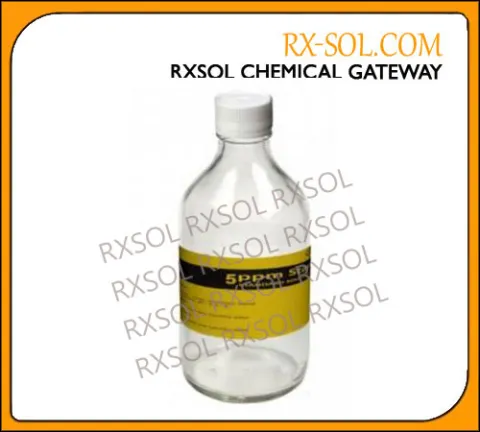
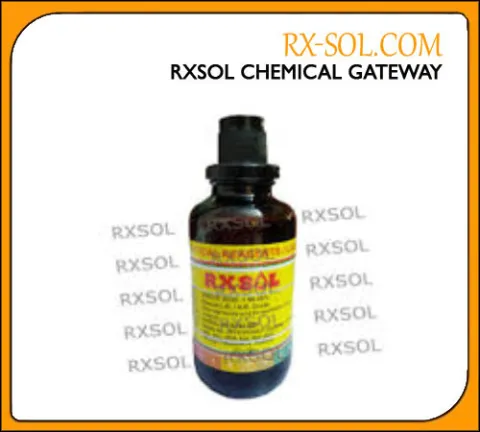
Toluene Lab Grade 2.5 Ltrs Glass Bottle
- Part number
- RXSOL-20-1202-002
- Category
- Wall Wash Test Kit
- Brand
- RXSOL
Overview
Toluene LR, Laboratory reagent pure solvent manufacturer, supplier and Exporter. We are keeping full range of Lab grade pure materials.
Applications
Colourless liquid, benzene-like odor. Soluble in alcohol, benzene, and ether; insoluble in water.
Hazard: Flammable, dangerous fire risk, toxic by ingestion, inhalation, and skin absorption.
Uses:Aviation gasoline and high octane blending stock. Also used as a solvent for paints and coating diluent, and thinner for nitrocellulose lacquers.
Dosage and directions
Item Name: TOLUENE,TECHNICAL
Spec Type, Grade, Class: NONE Hazard
Characteristic Code: F3
Read MSDS , before any types of usage......................
Characteristics and notes
Identifiers
CAS number 108-88-3
PubChem 1140
ChemSpider 1108
UNII 3FPU23BG52
DrugBank DB01900
KEGG C01455
ChEBI CHEBI:17578
ChEMBL CHEMBL9113
RTECS number XS5250000
Properties
Molecular formula C7H8 or C6H5CH3
Molar mass 92.14 g/mol
Appearance colorless liquid
Density 0.8669 g/mL (20 °C)
Melting point
−93 °C, 180 K
Boiling point
110.6 °C, 383.8 K
Solubility in water 0.47 g/L (20–25 °C)
Refractive index (nD) 1.497 (20 °C)
Viscosity 0.590 cP at 20 °C
Safety and SDS
Read the safety data sheet before handling. Wear suitable gloves and eye protection.
View safety data sheet
| Product Name | : | Toluene Lab Grade 2.5 Ltrs / 5 Ltr Bottle |
| Part Number | : | RXSOL-20-1202-002 |
Company Details:
RX MARINE INTERNATIONAL
105, A wing , BSEL , TECH PARK.
VASHI ,NEW BOMBAY 400703 INDIA
Branch : Kandla, Sikka, Dahej, Hazira, JNPT, Goa, Mangalore, Cochin, Tuticorin, Chennai, Kakinada, Vizag, Paradip, Kolkata, UAE, Singapore.
| Phone | : | +91 22 27815541 / 42 |
| Fax | : | +91 22 2781 1318 :::AOH :0091 9821214367 |
| : | rxsolchemicals@gmail.com |
| Name of Substance | Cas Number | EINECS No | Wt.% | Symbol |
| Toluene | 108-88-3 | 203-625-9 | 100% | Xi, Xn |
| Signal Word | Danger |
| Hazard Statements |
H225 Highly flammable liquid and vapour. H304 May be fatal if swallowed and enters airways. H315 Causes skin irritation. H336 May cause drowsiness or dizziness. H361d Suspected of damaging the unborn child. H373 May cause damage to organs (Central nervous system) through prolonged or repeated exposure. |
| Precautionary statements - prevention |
P210 Keep away from heat/sparks/open flames/hot surfaces. No smoking. |
| Precautionary statements - response |
P403 + P233 Store in a well-ventilated place. Keep container tightly closed. According to the criteria, the general hazard statement can be replaced by the hazard statement indicating only the property of concern, where either fertility or developmental effects are proven to be not relevant. See Annex VI, 1.2.3, General hazard statement not specifying the route of exposure as the necessary information is not available. See Annex VI, 1.2.2. Get medical attention/advice if you feel unwell |
| After Inhalation | Fresh air. Call in physician. |
| Skin contact | Take off immediately all contaminated clothing. Rinse skin with water/ shower. Consult a physician. |
| Eye contact | Rinse out with plenty of water. Call in ophthalmologist. Remove contact lenses.After swallowing: caution if victim vomits. Risk of aspiration! Keep airways free. Call a physician immediately. Pulmonary failure possible after aspiration of vomit. |
| Most important symptoms and effects, both acute and delayed | Irritant effects, Headache, Drowsiness, Dizziness, Nausea, Vomiting, inebriation, Convulsions, somnolence, Circulatory collapse, CNS disorders, respiratory paralysis, respiratory arrest, Unconsciousness, death |
| Indication of any immediate medical attention and special treatment needed | No information available. |
| Suitable extinguishing media | Foam, Carbon dioxide (CO2), Dry powder. |
| Unsuitable extinguishing media | For this substance/mixture no limitations of extinguishing agents are given. |
| Special hazards arising from the substance or mixture |
Combustible. Pay attention to flashback. Vapours are heavier than air and may spread along floors. Development of hazardous combustion gases or vapours possible in the event of fire. Forms explosive mixtures with air at ambient temperatures. |
| Advice for firefighters |
Special protective equipment for firefighters Stay in danger area only with self-contained breathing apparatus. Prevent skin contact by keeping a safe distance or by wearing suitable protective clothing. |
| Further information | Remove container from danger zone and cool with water. Prevent fire extinguishing water from contaminating surface water or the ground water system. |
|
Personal precautions, protective equipment and emergency procedures |
Advice for non-emergency personnel: Do not breathe vapours, aerosols. Avoid substance contact. Ensure adequate ventilation. Keep away from heat and sources of ignition. Evacuate the danger area, observe emergency procedures, consult an expert. Advice for emergency responders: Protective equipment see section 8. |
| Environmental precautions | Do not let product enter drains. Risk of explosion. |
| Methods and materials for containment and cleaning up | Cover drains. Collect, bind, and pump off spills. Observe possible material restrictions (see sections 7 and 10). Take up carefully with liquid-absorbent material (e.g. Chemizorb®). Dispose of properly. Clean up affected area. |
| Reference to other sections | Indications about waste treatment see section 13. |
|
Advice on safe handling |
Observe label precautions. Work under hood. Do not inhale substance/mixture. Avoid generation of vapours/aerosols. |
|
Advice on protection against fire and explosion |
Keep away from open flames, hot surfaces and sources of ignition. Take precautionary measures against static discharge. |
|
Hygiene measures |
Immediately change contaminated clothing. Apply preventive skin protection. Wash hands and face after working with substance. |
|
Conditions for safe storage, including any incompatibilities |
Keep container tightly closed in a dry and well-ventilated place. Keep away from heat and sources of ignition. |
| Specific end use(s) |
Apart from the uses mentioned in section 1.2 no other specific uses are stipulated.
|
|
Hand protection |
Glove material: Viton (R)
Glove thickness: 0.70 mm Break through time: > 480 min
splash contact:
Glove material: Viton (R) Glove thickness: 0.70 mm Break through time:> 480 min The protective gloves to be used must comply with the specifications of EC Directive 89/686/EEC and the related standard EN374, for example KCL 890 Vitoject® (full contact), KCL 890 Vitoject® (splash contact). The breakthrough times stated above were determined by KCL in laboratory tests acc. to EN374 with samples of the recommended glove types. This recommendation applies only to the product stated in the safety data sheet<(>,<)> supplied by us and for the designated use. When dissolving in or mixing with other substances and under conditions deviating from those stated in EN374 please contact the supplier of CE-approved gloves (e.g. KCL GmbH, D-36124 Eichenzell, Internet: www.kcl.de). |
|
Other protective equipment |
Flame retardant antistatic protective clothing. |
|
Respiratory protection |
Required when vapours/aerosols are generated. |
| Environmental exposure controls |
Do not let product enter drains. Risk of explosion. |
| Form | Liquid |
| Colour | Colourless |
| Odour | Characteristic |
| Odor Threshold | 0.2 - 68.6 ppm |
| pH | Not Applicable |
| Melting Point | -95 °C |
| Boiling Point | 110.6 °C at 1,013 hPa |
| Flash Point | 4 °C at 1,013 hPa Method: c.c. |
| Evaporation Rate | No information available. |
| Flammability (solid, gas) | No information available. |
| Explosive limits |
Lower explosion limit 1.1 %(V) Upper explosion limit 7.1 %(V) |
| Vapour pressure | 29 hPa at 20 °C |
| Vapour Density | 3.18 |
| Density | 0.87 g/cm3 at 20 °C |
| Relative density | No information available. |
| Water solubility | 0.52 g/l at 20 °C |
| Partition coefficient: n-octanol/water | log Pow: 2.65(experimental) (IUCLID) Bioaccumulation is not expected. |
| Auto-ignition temperature | No information available. |
| Decomposition temperature | Distillable in an undecomposed state at normal pressure. |
| Viscosity, dynamic | 0.6 mPa.sat 20 °C |
| Explosive properties | Not classified as explosive. |
| Oxidizing properties | None |
| Ignition temperature | 535 °C Method: DIN 51794 |
| Viscosity, kinematic | 0.7 mm2/s at 20 °C |
| Conductivity | < 0.01 μS/cm |
|
Hazardous Pollymerization: No |
Condition To Avoid Pollymerization : NA |
|
Stability : Stable |
Condition To Avoid Instability : NA |
|
Materials and Conditions To Avoid: Strong Oxidizing agents Hazardous Docompositions Products : None |
|
|
Acute oral toxicity |
LD50 Rat: 5,580 mg/kg. Tested according to Directive 92/69/EEC. |
|
Symptoms |
Nausea, Vomiting |
|
Acute inhalation toxicity |
LC50 Rat: 25.7 mg/l; 4 h ; vapour OECD Test Guideline 403 |
|
Symptoms |
Irritation symptoms in the respiratory tract. Absorption. |
| Acute dermal toxicity | LD50 Rabbit: 12,124 mg/kg |
| Skin irritation |
Rabbit Result: irritating Repeated or prolonged exposure may cause skin irritation and dermatitis, due to degreasing properties of the product.Causes skin irritation. |
| Eye irritation |
Rabbit Result: No eye irritation (ECHA) Sensitisation :This information is not available.Germ cell mutagenicity Genotoxicity in vivo |
| Chromosome aberration test |
Rat (i.p.) Bone marrow Result: negative (ECHA) Genotoxicity in vitro In vitro mammalian cell gene mutation test Mouse lymphoma test Result: negative Method: OECD Test Guideline 476 |
| Ames test | Result: negative |
| Carcinogenicity | This information is not available. |
| Reproductive toxicity | This information is not available. |
| Teratogenicity | This information is not available. |
| CMR effects Teratogenicity: | Suspected of damaging the unborn child. Specific target organ toxicity - single exposure May cause drowsiness or dizziness.Target Organs: Central nervous system |
| Specific target organ toxicity | Repeated exposure May cause damage to organs through prolonged or repeated exposure. |
| Target Organs: |
Central nervous system Aspiration hazard : Aspiration hazard, Aspiration may cause pulmonary oedema and pneumonitis. |
| Further Information |
Systemic effects: After absorption of large quantities: Headache, Vomiting, Nausea, Dizziness, CNS disorders, inebriation, Convulsions, Circulatory collapse, respiratory paralysis, respiratory arrest, Unconsciousness, death.Other dangerous properties can not be excluded. This substance should be handled with particular care. |
|
Toxicity to fish |
LC50 Oncorhynchus mykiss (rainbow trout): 5.8 mg/l; 96 h (ECOTOX Database) |
|
Toxicity to daphnia and other aquatic invertebrates |
EC50 Daphnia magna (Water flea): 6 mg/l; 48 h |
|
Toxicity to algae |
IC50 Pseudokirchneriella subcapitata (green algae): 12 mg/l; 72 h (Lit.) |
| Toxicity to bacteria | EC50 Photobacterium phosphoreum: 20 mg/l; 30 min (Lit.) |
| Biodegradability | 69 - 81 %; 5 d; aerobic APHA NO. 219 (ECHA) Readily biodegradable |
| Theoretical oxygen demand (ThOD) | 3,130 mg/g (Lit.) |
| Bioaccumulative potential | Partition coefficient: n-octanol/water log Pow: 2.65 (experimental) (IUCLID) Bioaccumulation is not expected. |
| Mobility in soil |
Distribution among environmental compartments Adsorption/Soil log Koc: 2.15 (experimental) Moderately mobile in soils (Lit.) |
| Results of PBT and vPvB assessment | PBT/vPvB assessment not available as chemical safety assessment not required/not conducted. |
| Other adverse effects |
Henry constant 683 Pa*m³/mol (Lit.) Distribution preferentially in air. Discharge into th e environment must be avoided. |
| Waste treatmentMethods | Waste material must be disposed of in accordance with the national and local regulations. Leave chemicals in original containers. No mixing with other waste. Handle uncleaned containers like the product itself. See www.retrologistik.com for processes regarding the return of chemicals and containers, or contact us there if you have further questions. |
Land transport (ADR/RID)
| UN number | UN 1294 |
| Proper shipping name | TOLUENE |
| Class | 3 |
| Packing group | II |
| Environmentally hazardous | -- |
| Special precautions for user | yes |
| Tunnel restriction code | D/E |
| Inland waterway transport (ADN) | Not relevant |
Air transport (IATA)
| UN number | UN 1294 |
| Proper shipping name | TOLUENE |
| Class | 3 |
| Packing group | II |
| Environmentally hazardous | -- |
| Special precautions for user | yes |
Sea transport (IMDG)
| UN number | UN 1294 |
| Proper shipping name | TOLUENE |
| Class | 3 |
| Packing group | II |
| Environmentally hazardous | -- |
| Special precautions for user | yes |
| Transport in bulk according to Annex II of MARPOL 73/78 and the IBC Code | Not relevant |
|
Safety, health and environmental regulations/legislation specific for the substance or mixture National legislation |
Storage class |
| Chemical safety assessment | For this product a chemical safety assessment was not carried out. |
| Other Information |
The information above is believed to be accurate and represents the best information currently available to us. However, we make no warranty of merchantability or any other warranty, express or implied, with respect to such information, and we assume no liability resulting from its use. Users should make their own investigations to determine the suitability of the information for their particular purposes. In no event shall be liable for any claims, losses, or damages of any third party or for lost profits or any special, indirect, incidental, consequential or exemplary damages, howsoever arising, even if RX Marine International has been advised of the possibility of such damages. DISCLAIMER OF LIABILITY :The information in this SDS was obtained from sources which we believe are reliable. However, the information is provided without any warranty, express or implied, regarding its correctness. The conditions or methods of handling, storage, use or disposal of the product are beyond our control and may be beyond our knowledge. For this and other reasons, we do not assume responsibility and expressly disclaim liability for loss, damage or expense arising out of or in any way connected with the handling, storage, use or disposal of the product. This MSDS was prepared and is to be used only for this product. If the product is used as a component in another product, this MSDS information may not be applicable. |
Availability
LR grade Toluene in Glass Bottle exporter and supplier in Dubai, Sharjah, Abu Dhabi, Ajman, Fujairah, Barka, Muscat - Oman, Mumbai, Navi Mumbai - MIDC, Chennai, Visakhapatnam, Kandla - Gandhidham, Kolkata, Paradip.