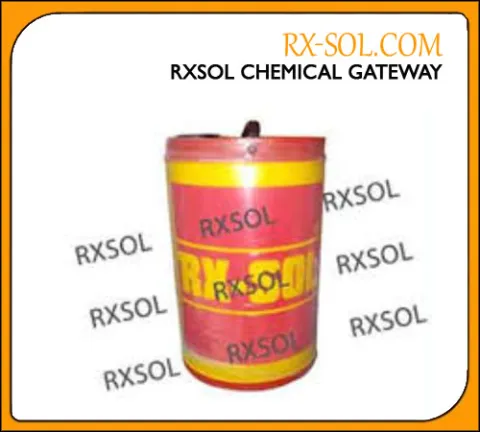
Poultry and Animal Feed Additive
ACTIVATED GUANIDINOACETIC ACID
- Part number
- RXSOL-97-3233-025
- Category
- Poultry and Animal Feed Additive
- Brand
- RXSOL
Overview
Technical specifications
Guanidinoacetic acid as a Performance-Enhancing agent.
Applications
Guanidinoacetic acid (GAA; molecular formula: C3H7N3O2) is an amino acid-like compound and relatively unexplored, although long-known, human metabolite.
Dosage and directions
Guanidinoacetate supplementation in broiler diets could be an effective technique for improving growth and Gastrointestinal Health.
Characteristics and notes
Guanidinoacetic acid GAA : molecular formula: C3H7N3O2
Safety and SDS
Read the safety data sheet before handling. Wear suitable gloves and eye protection.
View safety data sheet
| Product Name | Guanidine Carbonate |
| Part Number | RXSOL-19-3233-025 |
Company Details:....
RX MARINE INTERNATIONAL
105, A wing , BSEL , TECH PARK.
VASHI ,NEW BOMBAY 400703 INDIA
Branch : Kandla, Mumbai , Chennai, Vizag, Kolkata, UAE , OMAN , CANADA and KENYA
| Phone | +91 22 20871200 - 1400 |
| Fax | +91 22 27612100 :::AOH :0091 9821214367 |
| rxsolchemicals@gmail.com | |
| Website | www.rxmraine.com |
Substances
| Formula | (CH5N3)2 · CO3 |
| Molecular weight | 180,17 g/mol |
| CAS-No. | 593-85-1 |
| EC-No. | 209-813-7 |
| Component | Classification | Concentration |
| Diguanidinium Carbonate | ||
|
CAS-No. 593-85-1
EC-No 209-813-7
|
Acute Tox. 4; Eye Dam. 1;
H302, H318
|
<= 100 % |
For the full text of the H-Statements mentioned in this Section, see Section 16.
Classification of the substance or mixture
| Classification according to Regulation (EC) No 1272/2008 |
Acute toxicity, Oral (Category 4), H302
Serious eye damage (Category 1), H318
For the full text of the H-Statements mentioned in this Section, see Section 16.
|
Label elements
| Signal Word | Danger |
|
Hazard Statements |
H302 Harmful if swallowed.
H318 Causes serious eye damage.
|
|
Precautionary Statements |
P264 Wash skin thoroughly after handling.
P270 Do not eat, drink or smoke when using this product.
P280 Wear eye protection/ face protection.
P301 + P312 IF SWALLOWED: Call a POISON CENTER/ doctor if you feel unwell.
P305 + P351 + P338 IF IN EYES: Rinse cautiously with water for several minutes.
Remove contact lenses, if present and easy to do. Continue rinsing.
P501 Dispose of contents/ container to an approved waste disposal plant.
|
| Supplemental Hazard Statements | None |
| Reduced Labeling (<= 125 ml) | |
| Signal Word | Danger |
| Hazard statement(s) | H318 Causes serious eye damage. |
| Precautionary statement(s) |
P280 Wear eye protection/ face protection.
P305 + P351 + P338 IF IN EYES: Rinse cautiously with water for several minutes.
Remove contact lenses, if present and easy to do. Continue rinsing.
|
| Supplemental Hazard Statements | None |
| Other hazards |
This substance/mixture contains no components considered to be either persistent,
bioaccumulative and toxic (PBT), or very persistent and very bioaccumulative (vPvB) at
levels of 0.1% or higher.
|
Description of first aid measures
| General advice | Show this material safety data sheet to the doctor in attendance. |
| If inhaled | After inhalation: fresh air. |
| In case of skin contact | In case of skin contact: Take off immediately all contaminated clothing. Rinse skin with water/ shower. |
| In case of eye contact | After eye contact: rinse out with plenty of water. Immediately call in ophthalmologist. Remove contact lenses. |
| If swallowed | After swallowing: immediately make victim drink water (two glasses at most). Consult a physician. |
| Most important symptoms and effects, both acute and delayed | The most important known symptoms and effects are described in the labelling (see section 2.2) and/or in section 11 |
| Indication of any immediate medical attention and special treatment needed | No data available |
Extinguishing media
| Suitable extinguishing media | Water Foam Carbon dioxide (CO2) Dry powder |
| Unsuitable extinguishing media | For this substance/mixture no limitations of extinguishing agents are given. |
| Special hazards arising from the substance or mixture |
Carbon oxides
Nitrogen oxides (NOx)
Combustible.
Fire may cause evolution of: nitrogen oxides
Development of hazardous combustion gases or vapours possible in the event of fire.
|
| Advice for firefighters | In the event of fire, wear self-contained breathing apparatus. |
| Further information |
Suppress (knock down) gases/vapors/mists with a water spray jet. Prevent fire extinguishing water from contaminating surface water or the ground water system.
|
| Personal precautions, protective equipment and emergency procedures | Advice for non-emergency personnel: Avoid inhalation of dusts. Avoid substance contact. Ensure adequate ventilation. Evacuate the danger area, observe emergency procedures, consult an expert. For personal protection see section 8. |
| Environmental precautions | Do not let product enter drains. |
| Methods and materials for containment and cleaning up | Cover drains. Collect, bind, and pump off spills. Observe possible material restrictions (see sections 7 and 10). Take up dry. Dispose of properly. Clean up affected area. Avoid generation of dusts. |
| Reference to other sections | For disposal see section 13. |
| Precautions for safe handling | For precautions see section 2.2. |
| Conditions for safe storage, including any incompatibilities | |
| Storage conditions |
Tightly closed. Dry.
Recommended storage temperature see product label.
|
| Storage class | Storage class (TRGS 510): 13: Non Combustible Solids |
| Specific end use(s) | Apart from the uses mentioned in section 1.2 no other specific uses are stipulated |
| Eye/face protection | Use equipment for eye protection tested and approved under appropriate government standards such as NIOSH (US) or EN 166(EU). Tightly fitting safety goggles |
| Skin protection |
This recommendation applies only to the product stated in the safety data sheet,
supplied by us and for the designated use. When dissolving in or mixing with other
substances and under conditions deviating from those stated in EN 16523-1 please
contact the supplier of CE-approved gloves (e.g. KCL GmbH, D-36124 Eichenzell,
Internet: www.kcl.de).
Full contact
Material: Chloroprene
Minimum layer thickness: 0,65 mm
Break through time: 480 min
Material tested:KCL 720 Camapren®
This recommendation applies only to the product stated in the safety data sheet,
supplied by us and for the designated use. When dissolving in or mixing with other
substances and under conditions deviating from those stated in EN 16523-1 please
contact the supplier of CE-approved gloves (e.g. KCL GmbH, D-36124 Eichenzell,
Internet: www.kcl.de).
Splash contact
Material: Latex gloves
Minimum layer thickness: 0,6 mm
Break through time: 60 min
Material tested:Lapren® (KCL 706 / Aldrich Z677558, Size M). |
| Body Protection | Protective clothing |
| Respiratory protection |
Required when dusts are generated.
Our recommendations on filtering respiratory protection are based on the following standards: DIN EN 143, DIN 14387 and other accompanying standards relating to the used respiratory protection system.
Recommended Filter type: Filter type P3
The entre peneur has to ensure that maintenance, cleaning and testing of respiratory protective devices are carried out according to the instructions of the producer.
These measures have to be properly documented.
|
| Control of environmental exposure | Do not let product enter drains. |
| Appearance |
Form: powder, fine crystalline
Color: white
|
| Odor | Odorless |
| Odor Threshold | Not applicable |
| pH | 11,7 at 110 g/l at 20 °C |
| Melting point/freezing point | Melting point: 231 °C - OECD Test Guideline 102 |
| Initial boiling point and boiling range | No data available |
| Flash point | No data available |
| Evaporation rate | No data available |
| Flammability (solid, gas) | The product is not flammable. - Flammability (solids) |
| Upper/lower flammability or explosive limits | No data available |
| Vapor pressure | No data available |
| Vapor density | No data available |
| Density | 1,29 g/cm3 at 22 °C |
| Relative density | No data available |
| Water solubility | 450 g/l at ca.22 °C - OECD Test Guideline 105- completely soluble |
| Partition coefficient: n-octanol/water | log Pow: <= -1,43 at 22 °C - Bioaccumulation is not expected. |
| Autoignition temperature |
>= 400 °C
at 1.013 hPa - Relative self-ignition temperature for solids
|
| Decomposition temperature | No data available |
| Viscosity |
Viscosity, kinematic: No data available
Viscosity, dynamic: No data available
|
| Explosive properties | No data available |
| Oxidizing properties | None |
| Other safety information | |
| Bulk density | 500 - 700 kg/m3 |
| Reactivity | The following applies in general to flammable organic substances and mixtures: in correspondingly fine distribution, when whirled up a dust explosion potential may generally be assumed |
| Chemical stability | The product is chemically stable under standard ambient conditions (room temperature) |
| Possibility of hazardous reactions |
Violent reactions possible with:
Strong oxidizing agents
Strong acids
|
| Conditions to avoid | No information available |
| Incompatible materials |
No data available
|
| Hazardous decomposition products | In the event of fire: see section 5 |
Information on toxicological effects
| Acute toxicity |
LD50 Oral - Rat - female - 1.045 mg/kg
(OECD Test Guideline 401)
Inhalation: No data available
LD50 Dermal - Rat - male and female - > 2.000 mg/kg
(OECD Test Guideline 402)
|
| Skin corrosion/irritation |
Skin - Rabbit
Result: No skin irritation - 4 h
(OECD Test Guideline 404)
|
| Serious eye damage/eye irritation |
Eyes - Rabbit
Result: Irreversible effects on the eye
(OECD Test Guideline 405)
|
| Respiratory or skin sensitization |
Buehler Test - Guinea pig
Result: negative
(OECD Test Guideline 406)
|
| Germ cell mutagenicity |
Test Type: Ames test
Test system: Salmonella typhimurium
Metabolic activation: with and without metabolic activation
Method: OECD Test Guideline 471
Result: negative
Test Type: reverse mutation assay
Test system: Salmonella typhimurium
Metabolic activation: with and without metabolic activation
Method: Mutagenicity (Salmonella typhimurium - reverse mutation assay)
Result: negative
Test Type: Mutagenicity (mammal cell test): chromosome aberration.
Test system: Human lymphocytes
Metabolic activation: with and without metabolic activation
Method: OECD Test Guideline 473
Result: Positive results were obtained in some in vitro tests.
Test Type: Chromosome aberration test in vitro
Test system: Human lymphocytes
Metabolic activation: with and without metabolic activation
Method: OECD Test Guideline 473
Result: positive
Test Type: Micronucleus test
Species: Mouse
Cell type: Bone marrow
Application Route: Oral
Method: OECD Test Guideline 474
Result: negative
|
| Carcinogenicity | No data available |
| Reproductive toxicity |
No data available
|
| Specific target organ toxicity - single exposure | No data available |
| Specific target organ toxicity - repeated exposure |
Ingestion - May cause damage to organs through prolonged or repeated exposure.
- spleen
Remarks: Classified according to Regulation (EU) 1272/2008, Annex VI (Table 3.1/3.2)
|
| Aspiration hazard | No data available |
| Additional Information | |
|
Endocrine disrupting properties
Product
|
|
| Assessment |
The substance/mixture does not contain components considered to have endocrine disrupting properties according to REACH Article 57(f) or Commission Delegated regulation (EU) 2017/2100 or Commission Regulation (EU) 2018/605 at levels of 0.1% or higher.
RTECS: NC3675000
To the best of our knowledge, the chemical, physical, and toxicological properties have not been thoroughly investigated.
|
| Toxicity | |
| Toxicity to fish |
Semi-static test LC50 - Oncorhynchus mykiss (rainbow trout) - 1,78 mg/l - 96 h
(OECD Test Guideline 203)
|
|
Toxicity to daphnia
and other aquatic
invertebrates
|
Semi-static test EC50 - Daphnia magna (Water flea) - 1,1 mg/l - 48 h
(OECD Test Guideline 202)
|
| Toxicity to algae |
Static test ErC50 - Pseudokirchneriella subcapitata - 0,21 mg/l - 72 h
(OECD Test Guideline 201)
Static test EC10 - Raphidocelis subcapitata (freshwater green alga) - 0,075 mg/l - 72 h
(OECD Test Guideline 201)
|
| Persistence and degradability | The methods for determining biodegradability are not applicable to inorganic substances. |
| Bioaccumulative potential | No data available |
| Mobility in soil | No data available |
| Results of PBT and vPvB assessment | This substance/mixture contains no components considered to be either persistent, bioaccumulative and toxic (PBT), or very persistent and very bioaccumulative (vPvB) at levels of 0.1% or higher. |
| Endocrine disrupting properties | |
| Assessment | The substance/mixture does not contain components considered to have endocrine disrupting properties according to REACH Article 57(f) or Commission Delegated regulation (EU) 2017/2100 or Commission Regulation (EU) 2018/605 at levels of 0.1% or higher. |
| Other adverse effects | No data available . |
| Waste treatment Method | |
| Product | See www.retrologistik.com for processes regarding the return of chemicals and containers, or contact us there if you have further questions. |
| UN number | ADR/RID: IMDG: IATA: |
| UN proper shipping name |
ADR/RID: Not dangerous goods
IMDG: Not dangerous goods
IATA: Not dangerous goods
|
| Transport hazard class(es) | ADR/RID: IMDG: IATA: |
| Packaging group | ADR/RID: IMDG: IATA: |
| Environmental hazards | ADR/RID: no IMDG Marine pollutant: no IATA: no |
| Special precautions for user | |
| Further information | Not classified as dangerous in the meaning of transport regulations |
| Safety, health and environmental regulations/legislation specific for the substance or mixture | This material safety data sheet complies with the requirements of Regulation (EC) No. 1907/2006. |
| Other regulations | Observe work restrictions regarding maternity protection in accordance to Dir 92/85/EEC or stricter national regulations where applicable. Take note of Dir 94/33/EC on the protection of young people at work. |
| Chemical Safety Assessment | For this product a chemical safety assessment was not carried out |
| Other Information |
The information above is believed to be accurate and represents the best information currently available to us. However, we make no warranty of merchantability or any other warranty, express or implied, with respect to such information, and weassume no liability resulting from its use. Users should make their own investigations to determine the suitability of the information for their particular purposes. In no event shall be liable for any claims, losses, or damages of any third party or for lost profits or any special, indirect, incidental, consequential or exemplary damages, howsoever arising, even if Rx Marine International has been advised of the possibility of such damages. DISCLAIMER OF LIABILITY :The information in this SDS was obtained from sources which we believe are reliable. However, the information is provided without any warranty, express or implied, regarding its correctness. The conditions or methods of handling, storage, use or disposal of the product are beyond our control and may be beyond our knowledge. For this and other reasons, we do not assume responsibility and expressly disclaim liability for loss, damage or expense arising out of or in any way connected with the handling, storage, use or disposal of the product. This MSDS was prepared and is to be used only for this product. If the product is used as a component in another product, this MSDS information may not be applicable |