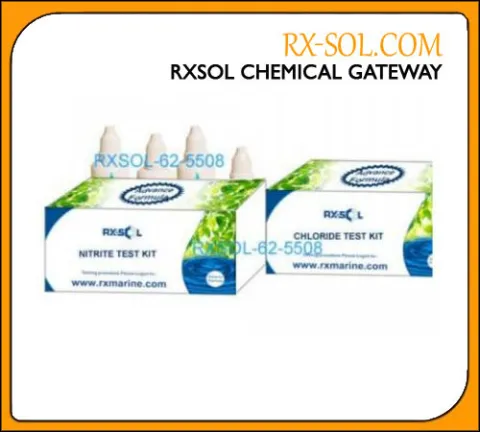
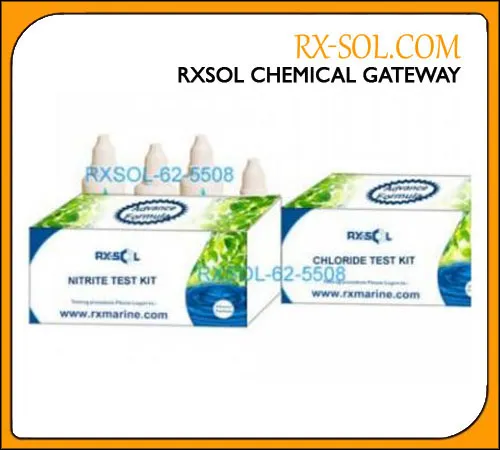
Chloride Test Kit
- Part number
- RXSOL-62-5506-001
- Category
- Test Kit For Water
- Brand
- RXSOL
Overview
Technical specifications
OFFER :::---
| Do not forget to ask JUMBO PACK OFFER ( TK | extra pack ) |
|---|---|
| BUY | GET 2 FREE TK extra pack |
Applications
PROCEDURE for test ( STEP WISE ):
- Measure 15 ml of SAMPLE WATER in graduated TEST TUBE / CYLINDER
- Add 1-2 drops of RXSOL TK1 and mix with the stirring rod , If sample turns red / PINK then follows 3rd step otherwise if sample remains colourless proceed to step 4.
- Add RXSOL TK2 drop by drop , mixing with the stirring rod until colour just disappears.
- Add 3 drops of RXSOL TK3 and mix with stirring rod , the sample will turn YELLOW.
- AddRXSOL TK4 carefully by counting drop by drop and mixing throughly until a light reddish / pink / brown colour develop.
Estimation of chloride as silver chloride in a given solution
To estimate chloride as silver chloride in the given solution of sodium chloride or hydrochloric acid.
Principal: The estimation of a soluble chloride is carried out by precipitating it as silver chloride in the presence of nitric acid using silver solution as a precipitating agent.
Cl- + Ag+ AgCl
The white curdy precipitate of silver chloride is filtered, washed with dil. nitric acid, dried and weighed.
Solution: Prepare a solution by dissolving 4.9g or 6.53 g or 8.157 g of sodium chloride per litre. 25 ml of such a solution will yield 0.3, or 0.4 or 0.5 g of AgCl residue respectively.
Reagents.
(a) Precipitating reagent : It is 0.1 N AgNO3 solution which is prepared by dissolving 4.22 g of silver nitrate (A.R.) in 250 ml of distilled water. (b) Washing solution : (i) One is 0.1N HNO3 which is prepared by adding 3 ml of conc. nitric acid (A.R.) to 497 ml of water, making the total volume 500 ml (ii) Other is 0.01N HNO3 which is prepared by adding 10 ml of 0.1N HNO3 (prepared as above) to 90 ml water making the total volume as 100 ml.
Procedure
(i) Precipitation : Measure out 25 ml of the given solution in a 500 ml beaker. To this add 50 ml of distilled water and 1 ml of conc. nitric acid (A.R.). Warm the solution at 700C and add 0.1N silver nitrate solution slowly with vigorous, constant stirring until precipitation is complete. Avoid a large excess of silver nitrate and carry out all operations in subdued light. Now wrap the beaker with a thick brown paper. Keep the beaker on a water bath for few minutes until the ppt. settles down and the supernatant liquid becomes clear. Allow the solution to cool a little and test the supernant liquid with a little more silver nitrate solution to ensure that precipitation is complete. If a ppt. appears, add more silver nitrate till the supernatant liquid yields a ppt. Again heat the beaker to 70 – 800 C
and stir constantly to coagulate the ppt. In case no ppt. appears, there is no need for adding excess of silver nitrate. After doing this test for complete precipitation, heat the beaker on a water bath. Cover the beaker with a watch glass and keep it about 25 minutes. Cool the beaker and keep it in dark for 1 hour to allow the ppt. to settle down.
(ii) Filtration and washing : Now transfer the supernatant liquid through a sintered glass crucible G – 3 previously cleaned, heated in an oven and weighed after cooling in a desiccator. Wash the ppt. by decantation 3 – 4 times with 0.1N HNO3 and the transfer the ppt. from the beaker to the crucible using a policeman to remove any adhering ppt. from the sides of the beaker. Now wash the ppt. in the crucible by 0.1N HNO3 until washings are free from Ag+ ions (when few-drops of dil. HCl are added to 10 – 15 drops of the filtrate, no turbidity should appear). Finally, wash
the ppt. with cold distilled water twice to free it from NO-
(iii) Drying and weighing : Dry the ppt. by keeping the crucible in an electric oven at 110 – 1200C for an hour. Allow the crucible to cool in a desiccator and weight it. Repeat the heating and cooling until constant weight is obtained.
Dosage and directions
RESULT : Each DROPS is equivalent to 8 PPM of CHLORIDES .
Small amount of sample is collected in a test tube and an indicator reagent is added to the sample. Use the dropper bottle, the titrant, until the color changes. To calculate the concentration just multiply the number of drops required by the titrant by a simple factor given in the test kit manual.
VIDEO HELP : https://www.youtube.com/watch?v=p_IgKoO49iE
Characteristics and notes
|
TK4 Drops |
Chloride value in |
PPM |
|
1 |
>>>>>>>>>>>>>>>>>>>>>>>>>>>>>>>>>>>>>>>>>>>> |
8 |
|
2 |
>>>>>>>>>>>>>>>>>>>>>>>>>>>>>>>>>>>>>>>>>>>> |
16 |
|
3 |
>>>>>>>>>>>>>>>>>>>>>>>>>>>>>>>>>>>>>>>>>>>> |
24 |
|
4 |
>>>>>>>>>>>>>>>>>>>>>>>>>>>>>>>>>>>>>>>>>>>> |
32 |
|
5 |
>>>>>>>>>>>>>>>>>>>>>>>>>>>>>>>>>>>>>>>>>>>> |
40 |
|
6 |
>>>>>>>>>>>>>>>>>>>>>>>>>>>>>>>>>>>>>>>>>>>> |
48 |
|
7 |
>>>>>>>>>>>>>>>>>>>>>>>>>>>>>>>>>>>>>>>>>>>> |
56 |
|
8 |
>>>>>>>>>>>>>>>>>>>>>>>>>>>>>>>>>>>>>>>>>>>> |
64 |
|
9 |
>>>>>>>>>>>>>>>>>>>>>>>>>>>>>>>>>>>>>>>>>>>> |
72 |
|
10 |
>>>>>>>>>>>>>>>>>>>>>>>>>>>>>>>>>>>>>>>>>>>> |
80 |
|
11 |
>>>>>>>>>>>>>>>>>>>>>>>>>>>>>>>>>>>>>>>>>>>> |
88 |
|
12 |
>>>>>>>>>>>>>>>>>>>>>>>>>>>>>>>>>>>>>>>>>>>> |
96 |
|
13 |
>>>>>>>>>>>>>>>>>>>>>>>>>>>>>>>>>>>>>>>>>>>> |
104 |
|
14 |
>>>>>>>>>>>>>>>>>>>>>>>>>>>>>>>>>>>>>>>>>>>> |
112 |
|
15 |
>>>>>>>>>>>>>>>>>>>>>>>>>>>>>>>>>>>>>>>>>>>> |
120 |
|
16 |
>>>>>>>>>>>>>>>>>>>>>>>>>>>>>>>>>>>>>>>>>>>> |
128 |
|
20 |
>>>>>>>>>>>>>>>>>>>>>>>>>>>>>>>>>>>>>>>>>>>> |
160 |
|
24 |
>>>>>>>>>>>>>>>>>>>>>>>>>>>>>>>>>>>>>>>>>>>> |
192 |
|
26 |
>>>>>>>>>>>>>>>>>>>>>>>>>>>>>>>>>>>>>>>>>>>> |
208 |
|
28 |
>>>>>>>>>>>>>>>>>>>>>>>>>>>>>>>>>>>>>>>>>>>> |
224 |
|
30 |
>>>>>>>>>>>>>>>>>>>>>>>>>>>>>>>>>>>>>>>>>>>> |
240 |
|
32 |
>>>>>>>>>>>>>>>>>>>>>>>>>>>>>>>>>>>>>>>>>>>> |
256 |
|
34 |
>>>>>>>>>>>>>>>>>>>>>>>>>>>>>>>>>>>>>>>>>>>> |
272 |
|
36 |
>>>>>>>>>>>>>>>>>>>>>>>>>>>>>>>>>>>>>>>>>>>> |
288 |
|
38 |
>>>>>>>>>>>>>>>>>>>>>>>>>>>>>>>>>>>>>>>>>>>> |
304 |
|
40 |
>>>>>>>>>>>>>>>>>>>>>>>>>>>>>>>>>>>>>>>>>>>> |
320 |
|
42 |
>>>>>>>>>>>>>>>>>>>>>>>>>>>>>>>>>>>>>>>>>>>> |
336 |
|
44 |
>>>>>>>>>>>>>>>>>>>>>>>>>>>>>>>>>>>>>>>>>>>> |
352 |
|
46 |
>>>>>>>>>>>>>>>>>>>>>>>>>>>>>>>>>>>>>>>>>>>> |
368 |
|
48 |
>>>>>>>>>>>>>>>>>>>>>>>>>>>>>>>>>>>>>>>>>>>> |
384 |
|
50 |
>>>>>>>>>>>>>>>>>>>>>>>>>>>>>>>>>>>>>>>>>>>> |
400 |
|
55 |
>>>>>>>>>>>>>>>>>>>>>>>>>>>>>>>>>>>>>>>>>>>> |
440 |
|
60 |
>>>>>>>>>>>>>>>>>>>>>>>>>>>>>>>>>>>>>>>>>>>> |
480 |
|
70 |
>>>>>>>>>>>>>>>>>>>>>>>>>>>>>>>>>>>>>>>>>>>> |
560 |
|
90 |
>>>>>>>>>>>>>>>>>>>>>>>>>>>>>>>>>>>>>>>>>>>> |
720 |
|
100 |
>>>>>>>>>>>>>>>>>>>>>>>>>>>>>>>>>>>>>>>>>>>> |
800 |
CHLORIDES Content up to 100 PPM level s are acceptable , in low pressure boiler , while more then 300 PPM level should be reduced by increased blowdown . Where as chlorides levels are very high the quality of the feed water should be checked in view to possible saline contamination.
Safety and SDS
Read the safety data sheet before handling. Wear suitable gloves and eye protection.
View safety data sheet
| Product Name | Chloride Test Kit |
| Part Number | RX:62-5506-001 |
Company Details:
RX MARINE INTERNATIONAL
105, A wing , BSEL , TECH PARK.
VASHI ,NEW BOMBAY 400703 INDIA
Branch : Kandla, Mumbai, Chennai, Vizag , Kolkata, UAE , OMAN & KENYA
| Phone | +91 22 27612100 |
| Fax | +91 22 2781 1318 :::AOH :0091 9821214367 |
| rxsolchemicals@gmail.com | |
| Website | www.rxmarine.com |
| Name of Substance | Cas Number | EINECS No | Wt.% |
| Potassium chromate | 7789-00-6 | 232-140-5 | 1-<2.5 |
| Signal Word | Danger |
| Hazard Statements |
H317 May cause an allergic skin reaction. H340 May cause genetic defects. H350i May cause cancer by inhalation |
| Precautionary statements - prevention |
P280 Wear protective gloves/protective clothing/eye protection. P273 Avoid release to the environment. P201 Obtain special instructions before use. P308+P313 IF exposed or concerned: Get medical advice/attention. P302+P352 IF ON SKIN: Wash with plenty of water. P405 Store locked up. |
| Eye Contact | Rinse opened eye for several minutes (at least 15 min) under running water. Call a doctor immediately |
| Skin Contact |
Instantly wash with water and soap and rinse thoroughly.If skin irritation or rash occurs: Get medical advice/attention.Clean contaminated small wounds very thoroughly immediately. Seek medical treatment |
| Inhalation: | Supply fresh air or oxygen; call for doctor |
| After swallowing |
Rinse out mouth and then drink 1-2 glasses of water.Seek immediate medical advice. |
| Most important symptoms and effects, both acute and delayed: |
irritations allergic reactions after swallowing and inhalation: absorption after inhalation: mucosal irritations, cough, shortness of breath |
General information: Extinguishing materials should be selected according to the surrounding area. The product itself is not combustible.
| Suitable extinguishing media | Use fire fighting measures that suit the environment |
| Special hazards arising from the substance or mixture |
The product is not combustible. Formation of toxic gases is possible during heating or in case of fire. Can be released in case of fire: chromium trioxide Dipotassium oxide |
| Protective equipment |
Wear self-contained breathing apparatus. Wear full protective suit. |
| Additional information | Collect contaminated fire fighting water separately. It must not enter drains. Dispose of fire debris and contaminated fire fighting water in accordance with official regulations. Ambient fire may liberate hazardous vapours. |
| Advice for non-emergency personnel |
Wear protective equipment. Keep unprotected persons away. Avoid substance contact. Ensure adequate ventilation Use breathing protection against the effects of fumes/dust/aeroso |
| Advice for emergency responders | Protective equipment: see section 8 |
| Environmental precautions | Stop leak if safe to do so. Contain spillage, and then collect with noncombustible absorbent material, (e.g. sand, earth, diatomaceous earth, vermiculite) and place in container for disposal according to local / national regulations (see section 13). Flush away traces with water. For large spills, dike spilled material or otherwise contain material to ensure runoff does not reach a waterway. |
| Methods and material for containment and cleaning up | Ensure adequate ventilation. Do not allow to dry out Absorb with liquid-binding material (sand, diatomite, universal binders). Dispose of contaminated material as waste according to item 13. |
| Reference to other sections | See Section 8 for information on personal protection equipment. See Section 13 for information on disposal |
| Advice on safe handling | Prevent formation of aerosols |
| Hygiene measures |
Do not get in eyes, on skin, or on clothing. Take off immediately all contaminated clothing. Store protective clothing separately. Wash hands during breaks and at the end of the work. Do not eat, drink or smoke when using this product. |
| Specific end use(s) | No further relevant information available |
| Engineering Control | Technical measures and appropriate working operations should be given priority over the use of personal protective equipment. See item 7 |
| Personal Protection | Protective clothing should be selected specifically for the workplace, depending on concentration and quantity of the hazardous substances handled. |
| Eye/face protection |
Safety glasses Use safety glasses that have been tested and approved in accordance with government standards such as EN 166 |
| Hand protection |
Protective gloves. Preventive skin protection by use of skin-protecting agents is recommended.After use of gloves apply skin-cleaning agents and skin cosmetics |
|
Material of gloves |
Nitrile rubber, NBR Recommended thickness of the material: ≥ 0.11 mm |
Gloves Suit
| Physical state | Fluid |
| Form | Solution |
| Colour | Yellow |
| Odour | Odourless |
| Odour threshold | Not applicable |
| Melting point/Freezing point | Not determined. |
| Boiling point or initial boiling point and boiling range | ~100°C |
| Flammability | Not applicable |
| Explosive properties | Product is not explosive. |
| Lower and upper explosion limit | |
| Lower | Not applicable. |
| Upper | Not applicable. |
| Vapor | Not applicable. |
| Flash point | Not applicable |
| Ignition temperature | Not applicable |
| Decomposition temperature | Not determined. |
| pH at 20°C | 9.5 |
| Kinematic viscosity | Not determined. |
| Solubility | - |
| Water | Fully miscible |
| Partition coefficient n-octanol/water (log value) | Not applicable (mixture). |
| Vapour pressure | Not determined |
| Density and/or relative density | - |
| Density at 20°C | 1.04 g/cm³ |
| Relative density | Not determined |
| Relative gas density | Not determined |
| Particle characteristics | Not applicable (liquid) |
| Corrosive to metals | Void |
| Oxidising properties | none |
| Solids content | < 3 % |
| Organic solvents | 0 % |
| Water | > 97 % |
| Recativity | See section 10.3 |
| Chemical stability | Stable at ambient temperature (room temperature) |
| Possibility of hazardous reactions | Reacts with reducing agents |
| Conditions to avoid | No further relevant information available |
| Incompatible materials |
Organic substances |
| Hazardous decomposition products | See section 5 |
| Information on components | CAS 7789-00-6: Sensitizing effect by inhalation and skin contact is possible by prolonged exposure |
| Eyes |
Based on available data, the classification criteria are not met. |
| Skin | Based on available data, the classification criteria are not met. |
| Carcinogenicity | May cause cancer by inhalation |
| STOT (specific target organ toxicity) | single exposure Based on available data, the classification criteria are not met |
| Chronic Exposure | Health injuries are not known or expected under normal use. |
| Additional toxicological information: | CAS 7789-00-6 Potassium chromate / CAS 7778-50-9 Potassium dichromate Main toxic effects [GESTIS]: acute: irritation/damage to mucous membranes and skin, sensitizing effect (skin/respiratory tract). Damage to kidneys, blood and liver. chronic: irritation/damage to the skin and mucous membranes, especially in the nose and throat. After penetration of the substance into wounds, these tend to form ulcers. Allergic skin and respiratory diseases. resorptive effects: primarily damage to the kidneys up to acute kidney failure; in addition, hemorrhagic diathesis, thrombocytopenia, anemia, possibly methemoglobinemia; rarely: rapid onset of CNS damage or hepatitis as a late consequence; also promoting respiratory infections |
| Environmental Effects | No data available |
| Toxicity to fish | No data available |
| Toxicity to daphnia and others | No data available |
| Toxicity to algae | No data available |
| Biodegradability | |
| Persistence and degradability | No data available |
| Bioaccumulative potential | No data available |
| Mobility in soil | No data available |
| Results of PBT and vPvB assessment | This mixture does not contain any substances that are assessed to be persistent, bioaccumulative and toxic (PBT) or very persistent and very bioaccumulative (vPvB), according to the criteria given in Annex XIII of Regulation (EC) No. 1907/2006. |
| Endocrine disrupting properties | The product does not contain substances with endocrine disrupting properties |
| Other adverse effects | Avoid transfer into the environment |
| Water hazard: | Do not allow product to reach ground water, water bodies or sewage system, even in small quantities. Danger to drinking water if even extremely small quantities leak into soil. |
| Waste treatment methods · Recommendation | Must not be disposed of together with household garbage. Do not allow product to reach sewage system. Hand over to disposers of hazardous waste. Disposal recommendation: as waste containing heavy metals (contains very small amounts of heavy metals) |
| European waste catalogue | 16 05 07* discarded inorganic chemicals consisting of or containing hazardous substances |
| Recommendation: | Disposal must be made according to official regulations |
| Recommended cleaning agent: | Water, if necessary with cleaning agent. |
Hazard Pictograms:
| UN Number | ADR, IMDG, IATA |
| Proper shipping name | ADR 3082 ENVIRONMENTALLY HAZARDOUS SUBSTANCE, LIQUID, N.O.S. (potassium chromate) · IMDG ENVIRONMENTALLY HAZARDOUS SUBSTANCE, LIQUID, N.O.S. (potassium chromate), MARINE POLLUTANT · IATA ENVIRONMENTALLY HAZARDOUS SUBSTANCE, LIQUID, N.O.S. (potassium chromate |
| Transport hazard class(es) 8 | |
| ADR/RID | ADR dcp`ódâ´ · Class 9 (M6) Miscellaneous dangerous substances and articles. · Label 9 · IMDG, IATA dcp`ódâ´ · Class 9 Miscellaneous dangerous substances and articles. |
| Packing group | IIIADR, IMDG, IATA |
| Environmental hazards | NoProduct contains environmentally hazardous substances: potassium chromate · Marine pollutant: Symbol (fish and tree) · Special marking (ADR): Symbol (fish and tree) · Special marking (IATA): Symbol (fish and tree) |
| Special precautions for user | Warning: Miscellaneous dangerous substances and articles. · Kemler Number: 90 · EMS Number: F-A,S-F · Stowage Category A |
| Marine pollutant | No |
| ADR/RID | |
| Hazard ID | 80 |
| · Transport/Additional information: | (E) |
| · ADR | |
| Limited quantities (LQ | F-A S-B |
| Excepted quantities (EQ) | |
| Transport category | 856 |
| Tunnel restriction code | 60 L |
| IMDG | 5L |
| Limited quantities (LQ) | Code: E1 |
| Excepted quantities (EQ) | Maximum net quantity per inner packaging: 30 ml Maximum net quantity per outer packaging: 1000 ml |
| Regulations |
In accordance with REACH Regulation (EC) No 1907/2006 as last amended with respect to SDS provisions by Commission Regulation (EU) 2015/830. COMMISSION REGULATION (EU) No 453/2010 of 20 May 2010 amending Regulation (EC) No 1907/2006 of the European Parliament and of the Council on the Registration, Evaluation, Authorisation and Restriction of Chemicals (REACH), establishing a European Chemicals Agency, amending Directive 1999/45/EC and repealing Council Regulation (EEC) No 793/93 and Commission Regulation (EC) No 1488/94 as well as Council Directive 76/769/EEC and Commission Directives 91/155/EEC, 93/67/EEC, 93/105/EC and 2000/21/EC. |
| Chemical safety assessment | No data available. |
| Further information |
FOR INDUSTRIAL USE. Water Hazard Class:. WGK 1. PR Number - 1821143. Product Declaration Number - P-14188 (Norwegian). |
| Other Information |
The information above is believed to be accurate and represents the best information currently available to us. However, we make no warranty of merchantability or any other warranty, express or implied, with respect to such information, and we assume no liability resulting from its use. Users should make their own investigations to determine the suitability of the information for their particular purposes. In no event shall be liable for any claims, losses, or damages of any third party or for lost profits or any special, indirect, incidental, consequential or exemplary damages, howsoever arising, even if RX Marine International has been advised of the possibility of such damages. |
Availability
Calculations
The constant weight of the crucible = a g
The constant weight of the crucible AgCl = b g
Weight of AgCl = (b – a ) g
Now AgCl ( 143.34 ) = Cl- ( 35.46 ) = NaCl ( 58.46 )
Here Simple Calculation is : 143.34 g of AgCl = 35.46 g of chloride
(b–a)gofAgCl = 35.46/143.34x(b–a)g of chloride or 25 ml of the given solution contains
= 35.46/143.34 ( b – a ) g of chloride
Amount of Cl- ion present in one liter of the solution
= 35.46/143.34 x( b – a )x1000/25
= 35.46 x( b – a ) x40 / 143.34 g
Similarly, the strength of NaCl solution in g/liter of the solution
= 58.46 x( b – a ) x 40 / 143.34 g