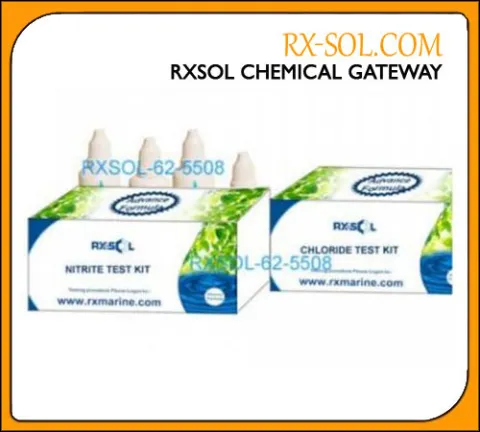
Chlorine Test Kit 0-2 ppm
- Part number
- RXSOL-62-5517-001
- Category
- Test Kit For Water
- Brand
- RXSOL
Overview
RESIDUAL CHLORINE TEST KIT,COLOUR COMPARATOR,
Applications
Chlorine
Range : 0.1, 0.2,0.4,0.7,1&2ppm as Chlorine.
Directions for use:
1. Add 2 drops of Chlorine Reagent in the test jar.
2. Pour water sample upto 10 ml mark and mix well. Wait for 5 minutes.
3. Now rinse the empty comparator tube with above solution and fill upto the half level of the comparator tube.
4. Insert this tube in sample slot of comparator. Compare the devloped colour with standard comparator colours.
5. Note down the ppm level of Chlorine as CL2
Safety and SDS
Read the safety data sheet before handling. Wear suitable gloves and eye protection.
View safety data sheet
| Product Name | RXSOL-62-5517-001 |
| Product Type | Chlorine Test Kit |
Company Details:
RX MARINE INTERNATIONAL
105, A wing , BSEL , TECH PARK.
VASHI ,NEW BOMBAY 400703 INDIA
| Phone | +91 22 65113333 / 5555 / 9999 |
| Fax | +91 22 2781 1318 :::AOH :0091 9821214367 |
| rxsolchemicals@gmail.com |
| Components | CAS Number | Proportion | Risk Phrases |
| Lactic acid | 50-21-5 | 10-<30% | R37/38, R41 |
| Sodium hydroxide | 1310-73-2 | <1% |
R35, R41 |
| Non hazardous component(s) | - | to 100% | - |
Not classified as a Dangerous Good under NZS 5433:2007 Transport of Dangerous Goods on Land.
Classified as hazardous according to criteria in the HS (Minimum Degrees of Hazard) Regulations 2001.
Subclasses:
- Subclass 6.1 Category E - Substances which are acutely toxic.
- Subclass 6.3 Category A - Substances that are irritating to the skin.
- Subclass 6.4 Category A - Substances that are irritating to the eye.
Water Treatment Chemicals (Subsidiary Hazard) Group Standard 2006
Hazard and Precautionary Information:
Warning. May be harmful if swallowed. Causes skin irritation. Causes serious eye irritation. Keep out of reach of children. Read Safety Data Sheet before use. Wash hands thoroughly after handling. Wear protective gloves/protective clothing/eye protection/face protection. Call a POISON CENTER or doctor/physician if you feel unwell. Do NOT induce vomitting. IF ON SKIN: Wash with plenty of soap and water. Specific treatment (see First Aid Measures on this Safety Data Sheet). If skin irritation occurs: Get medical advice/attention. Take off contaminated clothing before re-use. IF IN EYES: Rinse cautiously with water for several minutes. Remove contact lenses, if present and easy to do. Continue
rinsing. If eye irritation persists: Get medical advice/attention. In case of a substance that is in compliance with a HSNO approval other than a Part 6A (Group Standards) approval, a label must provide a description of one or more appropriate and achievable methods for the disposal of a substance in accordance with the Hazardous Substances (Disposal) Regulations 2001. This may also include any method of disposal that must be avoided.
| Inhalation: | Remove victim from area of exposure - avoid becoming a casualty. Seek medical advice if effects persist. |
| Skin Contact: |
If skin or hair contact occurs, immediately remove any contaminated clothing and wash skin and hair thoroughly with running water. If swelling, redness, blistering or irritation occurs seek medical assistance |
| Eye Contact: | Immediately wash in and around the eye area with large amounts of water for at least 15 minutes. Eyelids to be held apart. Remove clothing if contaminated and wash skin. Urgently seek medical assistance.Transport to hospital or medical centre. |
| Ingestion: | Rinse mouth with water. If swallowed, give a glass of water to drink. If vomiting occurs give further water. Seek medical assistance. |
| Medical attention and special treatment: | Treat symptomatically. Can cause corneal burns |
| Hazards from combustion products: | Non-combustible material. |
| Precautions for fire fighters and special protective equipment: |
Not combustible, however following evaporation of the water component of the material, the residual material can burn if ignited. On burning will emit toxic fumes. Fire fighters to wear self-contained breathing apparatus and suitable protective clothing if risk of exposure to vapour or products of combustion. |
| Suitable Extinguishing Media: |
Not combustible, however, if material is involved in a fire use: Fine water spray, normal foam, dry agent (carbon dioxide, dry chemical powder). |
| Emergency procedures: |
Clear area of all unprotected personnel. If contamination of sewers or waterways has occurred advise local emergency services. |
| Methods and materials for containment and clean up: |
Avoid accidents, clean up immediately. Wear protective equipment to prevent skin and eye contact. Mop up, or soak up spill with absorbent. Wash area down with excess water. |
Precautions for safe handling: Avoid skin and eye contact.
Conditions for safe storage: Store in a cool, dry, well ventilated place and out of direct sunlight. Store away from incompatible materials described in Section 10. Keep containers closed when not in use - check regularly for leaks.
Occupational Exposure Limits: No value assigned for this specific material by the New Zealand Occupational Safety and Health Service (OSH). However, Workplace Exposure Standard(s) for constituent(s): Sodium hydroxide: Ceiling 2 mg/m3
As published by the New Zealand Occupational Safety and Health Service (OSH).
WES - Ceiling (Workplace Exposure Standard - Ceiling). A concentration that should not be exceeded during any part of the working day.
These Exposure Standards are guides to be used in the control of occupational health hazards. All atmospheric contamination should be kept to as low a level as is workable. These exposure standards should not be used as fine dividing lines between safe and dangerous concentrations of chemicals. They are not a measure of relative toxicity.
Engineering controls:
Ensure ventilation is adequate and that air concentrations of components are controlled below quoted Exposure Standards. Keep containers closed when not in use.
Personal Protective Equipment:
The selection of PPE is dependant on a detailed risk assessment. The risk assessment should consider the work situation, the physical form of the chemical, the handling methods, and environmental factors.
Orica Personal Protection Guide No. 1, 1998: C - OVERALLS, SAFETY SHOES, CHEMICAL GOGGLES, GLOVES.
Wear overalls, chemical goggles and impervious gloves. Always wash hands before smoking, eating, drinking or using the toilet. Wash contaminated clothing and other protective equipment before storage or re-use. If risk of inhalation exists, wear suitable mist respirator meeting the requirements of AS/NZS 1715 and AS/NZS 1716.
| Appearance: | NA |
| Melting Point: | NA |
| pH at 20°C: | NA |
| Physical state: | Liquid |
| Odor: | NA |
| Boiling Point: | NA |
| Explosion Limit | NA |
| Density at 20°C: | NA |
| Solubility: | Soluble in water |
| Flash Point | NA |
| Chemical stability | Stable under normal conditions of use |
| Conditions to avoid: | None known |
| Incompatible materials: . | None known |
|
Hazardous decomposition products |
Oxides of carbon |
| Hazardous reactions: . | None known |
No adverse health effects expected if the product is handled in accordance with this Safety Data Sheet and the product label. Symptoms or effects that may arise if the product is mishandled and overexposure occurs are:
| Ingestion: | Swallowing can result in nausea, vomiting, diarrhoea, and abdominal pain |
| Eye contact: | A severe eye irritant. Corrosive to eyes; contact can cause corneal burns.Contamination of eyes can result in permanent injury |
| Skin contact: . | Contact with skin will result in irritation |
| Inhalation: . | Breathing in vapour may produce respiratory irritation |
Long Term Effects:No information available for the product.
Toxicological Data: No LD50 data available for the product.
Ecotoxicity Avoid contaminating waterways
Disposal methods: Refer to local government authority for disposal recommendations.
Road and Rail Transport
Not classified as a Dangerous Good under NZS 5433:2007 Transport of Dangerous Goods on Land.
Marine Transport
Not classified as Dangerous Goods by the criteria of the International Maritime Dangerous Goods Code (IMDG Code) for transport by sea; NON-DANGEROUS GOODS.
Air Transport
Not classified as Dangerous Goods by the criteria of the International Air Transport Association (IATA) Dangerous Goods Regulations for transport by air; NON-DANGEROUS GOODS.
Classification:
Classified as hazardous according to criteria in the HS (Minimum Degrees of Hazard) Regulations 2001.
Subclasses:
- Subclass 6.1 Category E - Substances which are acutely toxic.
- Subclass 6.3 Category A - Substances that are irritating to the skin.
- Subclass 6.4 Category A - Substances that are irritating to the eye.
Water Treatment Chemicals (Subsidiary Hazard) Group Standard 2006
This material safety data sheet has been prepared by SH&E Shared Services, Orica.
Reason(s) for Issue: 5 Yearly Revised Primary MSDS
This MSDS summarises to our best knowledge at the date of issue, the chemical health and safety hazards of the material and general guidance on how to safely handle the material in the workplace. Since Orica Limited cannot anticipate or control the conditions under which the product may be used, each user must, prior to usage, assess and control the risks arising from its use of the material.
If clarification or further information is needed, the user should contact their Orica representative or Orica Limited at the contact details on page 1.
Orica Limited's responsibility for the material as sold is subject to the terms and conditions of sale, a copy of which is available upon request.
DISCLAIMER OF LIABILITY :The information in this SDS was obtained from sources which we believe are reliable. However, the information is provided without any warranty, express or implied, regarding its correctness. The conditions or methods of handling, storage, use or disposal of the product are beyond our control and may be beyond our knowledge. For this and other reasons, we do not assume responsibility and expressly disclaim liability for loss, damage or expense arising out of or in any way connected with the handling, storage, use or disposal of the product. This MSDS was prepared and is to be used only for this product. If the product is used as a component in another product, this MSDS information may not be applicable.
Availability
Chlorine Test Kit 0-2 ppm manufacturer supplier distributor in Mumbai, Kandla, Kolkata, Vizag, Chennai, India, Fujairah, Dubai UAE, Muscat Oman, Kenya Africa. Get the best quality of Chlorine Test Kit 0-2 ppm at a competitive price from us. We have ready stock of Chlorine Test Kit 0-2 ppm in India, UAE Gulf, Oman, Kenya Africa. Contact us for bulk as well as small orders.