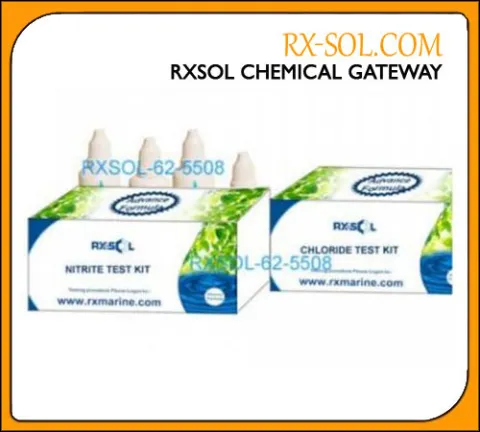
Hydrazine Test Kit Colorimetric Procedure
- Part number
- RXSOL-62-5524-001
- Category
- Test Kit For Water
- Brand
- RXSOL
Overview
Colorimetric Procedure
The objective is to maintain a hydrazine residual between 0.05-0.2 ppm depending on operating pressure and boiler designe. Actual consumption is determined under operating conditions. A normal dosage is approximately 1 ltr. per day, depending of system layout.
Hydrazine is a convenient reductant because the by-products are typically nitrogen gas and water. Thus, it is used as an ANTIOXIDANT, an oxygen scavenger, and a corrosion inhibitor in water boilers and heating systems.
Hydrazine is mainly used as a foaming agent in preparing polymer foams.
No oxygen is entering the boiler with the feed water when hydrazine is present in the water.
Technical specifications
Hydazine Dose Level
|
Low Pressure Boiler ( 0 to 40 bar ) |
0.10 to 0.2 ppm level |
|
Medium Pressure Boiler ( 41 to 60 bar ) |
0.1 to 0.15 ppm level |
|
High Pressure Boiler ( more then 60 bar) |
0.05 to 0.10 ppm level |
Applications
Directions for use : Based on Colorimetric Procedure
1. Take 5 ml of sample to be tested in the Test jar ( Before testing, samples must be cooled to 25oC by passing them through a cooler.). if necessary. Turbid samples are to be filtered with a filter paper.
2. Add 40 drop (2ml) of Reagent TK-16. Mix wel
3. Add 2 micro spoon full of Reagent TK-17. Mix well upto provider dissolves Completely. Wait for 10 minutes.
4. Now rinse the empty comparator tube with above solution and will upto the half level of the comparator tube.
5. Insert this tube in sample slot of comparator.
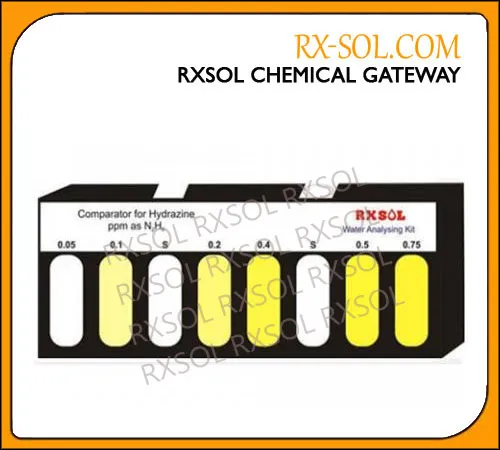
6. Compare the developed colour with standard comparator colours. Slide the comparator until the colors match. Check the mea- surement reading in the recess on the comparator reed. Mid values can be estimated
7. Note down the ppm level of Hydrazine as N2H4
8.After use, rinse out both measuring glasses thoroughly and seal them.
Note 1 ::: Studies showed that hydrazine was not stable on the sampling device, therefore, immediate extraction of samples after collection was recommended.
Note 2 ::: color is stable for 1 hours.
Sample of Hydrazine is Harmful. Handle with due care.
All open chemicals should be used only in a fume hood.
Avoid any skin contact with all chemicals. Immediately flush contaminated areas with copious amounts of water.
Wear safety glasses at all times.
PRINCIPLE of Hydrazine TEST for Boiler water and Water:::
Under acidic conditions, hydrazine combines with Hydrazine Test Reagent TK - 17 to form a yellow- colored complex. Color development follows and is stable after maximum color is developed in 10 to 15 minutes.
Dosage and directions
Always try to keep HYDRAZINE level at minimum level. As by the decomposition of hydrazine ammonia will be liberated and Ammonia in the presence of oxygen is corrosive to copper and copper alloys.
It will be necessary to test the hydrazine residuals in the boiler daily in order to obtain complete protection with minimum doses of hydrazine. If the hydrazine residual in the boiler is over 0.1 PPM, reduce the dosage of hydrazine until the boiler hydrazine residual falls below the recommended maximum of 0.1 PPM. If the hydrazine residual does not immediately drop below the 0.1 PPM level, the boiler should be blowdown to reduce the hydrazine level. New boilers, or those recently open for inspection and repair, may take several weeks to achieve a normal boiler hydrazine residual due to oxides. This is normal, and until a hydrazine residual is obtained in the boiler water, test the feed water for the hydrazine content. Maintain the hydrazine reading in the feed water between 0.02 and 0.03 PPM. No oxygen is entering the boiler with the feed water when hydrazine is present in the water. hydrazine may be dosed into the feed pump suction, more preferably, to the storage section of the deaerator, which will maximize the residence and reaction time. A separate dosing tank and pump set should be used for dosing hydrazine to the system. (Condensate Control may be fed with the hydrazine.) The estimated daily dose should be mixed with condensate and the pump should be to deliver the daily dosage over an entire 24 hour period. If a pump and tank set is not available, hydrazine (and Condensate ControL) can be added to the system through a tank and flowmeter into the atmospheric drain tank.
Characteristics and notes
The reagent that is used in this test is corrosive. Use protection for eyes and skin and be prepared to flush any spills with running water.
Wear protective gloves.
IF ON SKIN: Wash with plenty of soap and water.
IF IN EYES: Rinse cautiously with water for several minutes. Remove contact lenses, if present and easy to do. Continue rinsing.
Safety and SDS
Read the safety data sheet before handling. Wear suitable gloves and eye protection.
View safety data sheet
| Product Name | RXSOL-62-5524-001 |
| Product Type | Hydrazine Test KIT Method: photometric 0.005 - 2.00 mg/l N2H4 |
Company Details:
RX MARINE INTERNATIONAL
105, A wing , BSEL , TECH PARK.
VASHI ,NEW BOMBAY 400703 INDIA
Stock Point : Mumbai, Kandla, Chennai, Vizag, Kolkata, Fujairah
| Phone | +91 22 27815540 / 41 |
| Fax | +91 22 2781 1318 :::AOH :0091 9821214367 |
| rxsolchemicals@gmail.com |
|
Chemica Name |
Concentration |
CAS Number |
EC Number |
R Phrases* |
Symbols |
|
Formulatory Powder |
2.5-5 % |
------------- |
-------- |
Not Applicable |
Not Applicable |
|
Sodium Hydrogen Sulfate |
90-100 % |
7681-381 |
231-655-7 |
41 |
Xi |
|
Proprietory Neutralizer |
1-5 % |
----------- |
........ |
Not Applicable |
Not Applicable |
|
Odour |
Characteristic odour. |
|
Appearance |
Liquid, pale yellow, soluble in water. |
|
Contact with eyes |
Causes irritation. |
|
Contact with skin |
In cases of severe exposure, irritation may develop. |
|
Inhalation |
Vapours or aerosols may cause irritation of eyes, nose and respiratory tract. |
|
Ingestion |
The ingestion of significant quantities may cause gastro-intestinal disturbances. |
Labelling.(REGULATION (EC) No 1272/2008)
Hazard pictograms
Signal word Warning
Hazard statements
H290 May be corrosive to metals.
H317 May cause an allergic skin reaction. H319 Causes serious eye irritation.
Precautionary statements Prevention
P280 Wear protective gloves. Response
P302 + P352 IF ON SKIN: Wash with plenty of soap and water.
P305 + P351 + P338 IF IN EYES: Rinse cautiously with water for several minutes. Remove contact lenses, if present and easy to do. Continue rinsing.
Reduced labelling (≤125 ml)
Hazard pictograms
Signal word Warning
Hazard statements
H317 May cause an allergic skin reaction.
Precautionary statements .P280 Wear protective gloves.
|
Contact with skin |
Remove contaminated clothing immediately and drench affected skin with plenty of water. Then wash with soap and water Seek medical advice if necessary |
|
Contact with eyes |
If substance has got into eyes, immediately wash out with plenty of water for at least 15 minutes .Obtain immediate medical attention Ingestion, Never give anything by mouth to an unconscious person Give plenty of water to drink |
|
Ingestion |
Never give anything by mouth to anunconscious person . Give plenty of water to drink . Obtain immediate medical attention |
|
Inhalation |
Remove patient to fresh air. Keep warm and at rest, in a half up right position. Loosen clothing.Seek medical attention if irritation persists |
|
General |
In case of accident or if you feel unwell, seek medical advice immediately (show the label where possible)(S45) |
In case of skin contact: Take off immediately all contaminated clothing. Rinse skin with water/ shower. Consult a physician.
After eye contact: rinse out with plenty of water. Call in ophthalmologist. Remove contact lenses.
After swallowing: immediately make victim drink water (two glasses at most). Consult a physician.
Most important symptoms and effects, both acute and delayed
Irritant effects, Allergic reactions, CNS disorders. The following applies to aromatic amines in general: systemic effect: methaemoglobinaemia with headache, cardiac dysrhythmia, drop in blood pressure, dyspnoea, and spasms, principal symptom: cyanosis (blue discolouration of the blood).
Indication of any immediate medical attention and special treatment needed.
|
Fire-fighting measures |
Use extinguishing measures that are appropriate to local circumstances and the surrounding environment. Smoke from fires is irritating Not flammable. In case of fire use extinguishing media appropriate to surrounding conditions |
|
Personal Precautions |
Wear protective clothing as per section 8 |
|
Environmental Precautions |
No special precautions are required for this product Immediate Actions. Shut off source of leak if safe to do so |
|
Clean Up Actions |
Absorb spillage in inert material and shovel up. Flush spill area with copious amounts of water |
|
Handling |
The usual precautions for handling chemicals should be observed. Eyewash bottles should be available - See Section 8. Advice for non-emergency personnel: Do not breathe vapours, aerosols. Avoid substance contact. Ensure adequate ventilation. Evacuate the danger area, observe emergency procedures, consult an expert. |
|
Storage |
Keep only in the original container in a cool, well ventilated place (S3/9/49) Protect from frost. After inhalation: use fresh air. Take up with liquid-absorbent and neutralising material |
|
Exposure Limits |
There are no recommended or established controls for this product. |
|
Exposure controls |
No special ventilation is required unless the product is used in a spray form. |
|
Occupational exposure controls |
Wear suitable protective clothing, including eye/face protection and gloves (plastic or rubber are recommended) No respiratory protection is required unless subject to contact with substance mist. Individual protection measures Protective clothing needs to be selected specifically for the workplace, depending on concentrations and quantities of the hazardous substances handled. The chemical resistance of the protective equipment should be enquired at the respective supplier. Eye/face protection Safety glasses
Hand protection full contact: Glove material: Glove thickness: Break through time: Glove material: Glove thickness: Break through time:
Nitrile rubber 0.11 mm
Nitrile rubber 0.11 mm The protective gloves to be used must comply with the specifications of EC Directive 89/686/EEC and the related standard EN374, |
|
Odour |
Characteristic Odour |
|
Appearance |
Liquid, pale yellow, soluble in water |
|
pH |
1-1.5 at 5 - 10 % concentration |
|
Boiling point |
No Information |
| Relative Density with Water = 1 | 2662 |
|
Vapour pressure |
not known |
- This article is considered stable under normal conditions
Chemical stability : The product is chemically stable under standard ambient conditions (room temperature) .
Possibility of hazardous reactions : Violent reactions possible with: The generally known reaction partners of water. Strong oxidizing agents, Bases
Conditions to avoid : No information available
Incompatible materials : Animal/vegetable tissues
Gives off hydrogen by reaction with metals. Metals
Hazardous decomposition products : In the event of fire: See section 5.
|
Toxicological information |
No experimental data available Inhalation. |
|
Contact with skin |
In cases of severe exposure, redness and irritation may develop. |
|
Contact with eyes |
Causes irritation. |
|
Ingestion |
May cause gastrointestinal disturbances |
|
Carcinogenicity |
No evidence of carcinogenic effects. |
Information on toxicological effects Mixture
Acute oral toxicity : This information is not available.
Acute inhalation toxicity Symptoms: Possible symptoms:, mucosal irritations
Acute dermal toxicity :This information is not available.
Skin irritation : This information is not available.
Eye irritation : Mixture causes serious eye irritation.
Sensitisation : Mixture may cause an allergic skin reaction.
Germ cell mutagenicity : This information is not available.
Specific target organ toxicity - single exposure This information is not available.
Specific target organ toxicity - repeated exposure This information is not available.
|
Ecotoxicity |
This product does not contain ingredients which are classified in the EU as dangerous for the environment. |
|
Mobility |
Completely soluble in water |
|
Persistence and Biodegradability |
Its main ingredients will either dissolve rapidly and dissociate in water or are readily/inherently biodegradable. |
|
Bioaccumulation Potential |
Bioaccumulation of the components in this product is insignificant. Other Adverse Effects |
After skin contact: irritative response if not handled appropriately. After eye contact: corneal lesions may occur under certain circumstances. After swallowing: damage to the affected mucous membranes possible.
The following applies to aromatic amines in general: systemic effect: methaemoglobinaemia with headache, cardiac dysrhythmia, drop in blood pressure, dyspnoea, and spasms, principal symptom: cyanosis (blue discolouration of the blood).
Other dangerous properties can not be excluded.
Handle in accordance with good industrial hygiene and safety practice.
Components
sulphuric acid
Germ cell mutagenicity
Genotoxicity in vitro Ames test
Salmonella typhimurium Result: negative (HSDB)
4-dimethylaminobenzaldehyde Acute oral toxicity
LD50 Rat: > 2,000 mg/kg OECD Test Guideline 423
Skin irritation
In vitro study
Result: negative
OECD Test Guideline 439
Eye irritation
In vitro study
Result: Eye irritation OECD Test Guideline 492
In vitro study
Result: non-corrosive OECD Test Guideline 437
Catalogue No. Product name
Carcinogenicity
This information is not available.
Reproductive toxicity
This information is not available.
Teratogenicity
This information is not available.
|
Classification |
This material and/or its container must be disposed of as hazardous waste EU Waste class |
|
Disposal considerations |
Do not discharge into drains or the environment, dispose to an authorised waste collection point Disposal should be in accordance with local, state or national legislation |
Ecological information Mixture
Toxicity : No information available.
Persistence and degradability : No information available.
Bioaccumulative potential : No information available.
Mobility in soil : No information available.
Results of PBT and vPvB assessment : PBT/vPvB assessment not available as chemical safety assessment not required/not conducted.
Other adverse effects : Discharge into the environment must be avoided.
Components
sulphuric acid Toxicity to fish
static test LC50 Lepomis macrochirus (Bluegill sunfish): > 16 - < 28 mg/l; 96 h Analytical monitoring: yes(ECHA)
Toxicity to daphnia and other aquatic invertebrates
static test EC50 Daphnia magna (Water flea): > 100 mg/l; 48 h Analytical monitoring: yes
OECD Test Guideline 202
Toxicity to algae
static test EC50 Desmodesmus subspicatus (green algae): > 100 mg/l; 72 h Analytical monitoring: yes
OECD Test Guideline 201
Toxicity to fish (Chronic toxicity)
flow-through test NOEC Cyprinodon sp. (minnow): 0.025 mg/l; 65 d
Analytical monitoring: yes(ECHA)
- Not classified as hazardous for transport
|
Risk Phrases |
Irritating to eyes (R36) |
|
Safety Phrases Irritant |
In case of contact with eyes, rinse immediately with plenty of water and seek medical advice (S26) Wear suitable gloves and eye/face protection (S37/39) |
Text of R and S phrase codes used in this safety data sheet:- R34: Causes burns; R36: Irritating to eyes; R37: Irritating to the respiratory system; R41: Risk of serious damage to eyes.
The SDS is a Hazard Communication tool and should be used to assist in the Risk Assessment. Many factors determine whether the reported Hazards are Risks in the workplace or other settings. Risks may be determined by reference to Exposures Scenarios.
For detailed advice on Personal Protective Equipment, refer to the following EU CEN Standards: EN 166 Personal eye-protection
EN 340 Protective clothing
EN 374 Protective gloves against chemicals and micro-organisms
EN 13832 Footwear protecting against chemicals EN 133 Respiratory protective devices
In case of skin contact: Take off immediately all contaminated clothing. Rinse skin with water/ shower. Consult a physician.
After eye contact: rinse out with plenty of water. Call in ophthalmologist. Remove contact lenses.
After swallowing: immediately make victim drink water (two glasses at most). Consult a physician.
4.2 Most important symptoms and effects, both acute and delayed
irritant effects, Allergic reactions, CNS disorders
The following applies to aromatic amines in general: systemic effect: methaemoglobinaemia with headache, cardiac dysrhythmia, drop in blood pressure, dyspnoea, and spasms, principal symptom: cyanosis (blue discolouration of the blood).
4.3 Indication of any immediate medical attention and special treatment needed
No information available.
DISCLAIMER OF LIABILITY :The information in this SDS was obtained from sources which we believe are reliable. However, the information is provided without any warranty, express or implied, regarding its correctness. The conditions or methods of handling, storage, use or disposal of the product are beyond our control and may be beyond our knowledge. For this and other reasons, we do not assume responsibility and expressly disclaim liability for loss, damage or expense arising out of or in any way connected with the handling, storage, use or disposal of the product. This MSDS was prepared and is to be used only for this product. If the product is used as a component in another product, this MSDS information may not be applicable.
Availability
Where Hydrazine Test Kit used ?
HYDRAZINE TEST KIT is used for the determination of Hydrazine content in the Boiler’s Water. The test must be performed when in the vessel’s Boiler Water Treatment used hydrazine ingredient to control rust and corrosion RXSOL-50-5022-025 / RXSOL-50-5007-025 / RXSOL-19-1541-025. This is an activated hydrazine solution (Hydrazine with a catalyst for faster reaction with Dissolved Oxygen,) and applied for marine and industrial Boilers in low, medium and high pressures.
Benefit of Hydrazine Test Kit ?
Following the procedure above, the concentration in ppm of Hydrazine in the Boiler Water will be obtained. According to the Boiler’s working conditions, and the results obtained the dosage of Oxygen Scavenger / Hydrazine must be adjusted considering the dose chart. For effective boiler water treatment with Hydrazine and in order to avoid any problem of Oxygen corrosion, the test at the initial period of use of RXSOL Oxygen Scavenger must be performed every day. Once a small concentration of Hydrazine obtained in the Boiler water then the test could be repeated every 2–3 days.
Limitation of Hydrazine Dose ?
Control of Hydarazine level in Boiler water is very important. As proper level maintenance protect metal machinery parts from corrosion, However, precautions must be taken to prevent excess dose of hydrazine chemical as excess hydrazine will begin to decompose at temperature above 200oC to form Ammonia.
Hydrazine is one of popular an alternative Oxygen Scavenger. It is very important to protect boiler components from feed boiler water corrosion.