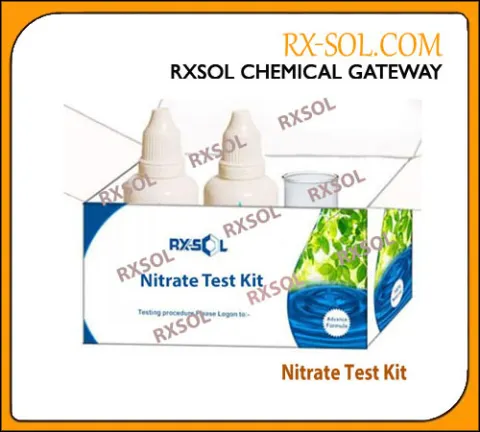
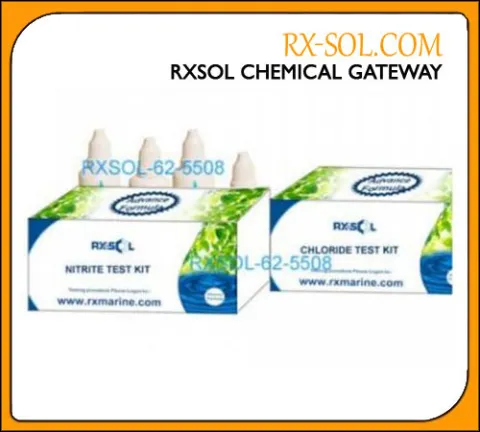
Nitrate Test Kit
- Part number
- RXSOL-62-6046-001
- Category
- Test Kit For Water
- Brand
- RXSOL
Overview
Nitrate Test Kit based on Brucine method. Manufacturer and supplier in Mumbai, Kandla, Chennai, Vizag, Kolkata, Fujairah, Dubai, Sharjah.
Technical specifications
Specifications:
| Range |
0 to 50 mg/L (ppm) as NO3 -N |
| Smallest Increment | 10 mg/L (ppm) NO3 -N |
| Analysis Method | Colorimetric |
| Sample Size | 10 mL |
| Number of Tests | 100 |
| Case Dimensions | 230x59x70 mm (9.0x2.3x2.8") |
| Shipping Weight | 156 g (6.0 oz.) |
Applications
Brucine Method :
Uses of Brucine for Nitrate Determination from natural waters. This method gives results in the range of 0.05 to 0.8 mg per litre nitrate nitrogen. Change of colour directly proportional of nitrate concentration.
Determination of Nitrate from water can be performed by Phenol Disulfonic Acid Method and tentatively Brucine method.
In Phenol Disulfonic Acid Method, excess chloride interference the result while Brucine method is not significantly influenced by variation of chloride concentration up to 0 to 20 grams per litre. Brucine method highly reproducible results in the range of 0.05 to 0.8 mg per litre nitrate nitrogen. The colour produced bears an essentially linear relationship to the nitrate concentration level.
Brucine methods are common for recoveries of nitrate from natural waters but brucine method is not recommended for untreated sewage from which recoveries are poor.
Dosage and directions
Test for nitrate in water :
Reagents: Brucine solution Conc. Sulphuric acid
Procedure:
. Take 1 ml of sample water in a tube with a pipette.
. Add 2 drops of Brucine solution to the tube.
. Add 2-3 drops of Conc. Sulphuric acid to the tube.
. Shake well and wait for 20 minutes.
. The solution will turn yellow in presence of nitrate. The darker the shade, the more is the concentration of nitrate in water.
Characteristics and notes
Significance and Use:
Nitrate ions are present in trace amounts in surface water and in higher levels in some groundwater. Nitrate is found only in small quantities in domestic wastewater but can reach higher concentration (up to 30 mg/L as nitrogen) in the outflow of nitrifying biological treatment plants. Excessive amounts can contribute to methaemoglobinemia: infant death and adult illness. In order to prevent this, a 10 mg/L limit (as nitrogen) has been imposed on drinking water.
NOTE: mg/L is equivalent to ppm (parts per million).
Chemical Reaction:
Nitrates are reduced to nitrites in the presence of Cadmium. The nitrites thus produced react with the reagent to yield an orange compound. The amount of color developed is proportional to the concentration of nitrate present in the aqueous sample.
Safety Data Sheets:
The chemicals contained in this kit may be hazardous if improperly handled. Read the relevant Safety Data Sheet before performing this test.
Safety and SDS
Read the safety data sheet before handling. Wear suitable gloves and eye protection.
View safety data sheet
| Product Name |
Nitrate Test Kit |
| Product Type |
RXSOL-62-6046-001 |
Company Details:
RX MARINE INTERNATIONAL
105, A wing , BSEL , TECH PARK.
VASHI ,NEW BOMBAY 400703 INDIA
| Phone | +91 22 65113333/ 5555 / 9999 / 27611360 / 27815540 |
| Fax | +91 22 2781 1318 :::AOH :0091 9322594669 |
| rxsolchemicals@gmail.com |
| SARA 313 | Component | CAS Number | Percent Comp. | Dimension | Exposure Limits |
| Chromatropic Acid, Disodium Salt | CAS# 129-96-4 | 1 – 5% | W/W | Oral rat LD50 > 5000 mg/kg | |
| Sodium Sulfanilate | CAS# 515-74-2 | 5 – 15% | W/W | None Established | |
| Potassium Pyrosulfate | CAS# 7790-62-7 | 1 – 10% | W/W | Oral rat LD50 2340 mg/kg | |
| Potassium Phosphate, Monobasic | CAS# 7778-77-0 | 75 – 85% | W/W | Oral rat LD50 7100 mg/kg | |
| 1,2- Cyclohexanediaminetet raacetic Acid Trisodium Salt | CAS# 36679-96-6 | 1 – 5% | W/W | None established |
|
Emergency Overview: |
Causes eye burns may cause skin and respiratory tract irritation |
|
Inhalation: |
May cause: irritation of nose and throat |
|
Ingestion: |
May cause: irritation of the mouth and esophagus Very large doses may cause: gastrointestinal disturbances, cardiac depression, kidney damage |
|
Skin: |
May cause irritation |
|
Eye Contact: |
Causes eye burns. |
| Chronic Exposure: | None reported |
| Aggravated by Exposure: |
Pre-existing: eye conditions, kidney conditions, central nervous system Diseases |
FIRST AID:
| SKIN: | Wash exposed area with soap and water. If irritation persists, seek medical attention. |
| EYES: | Wash eyes with plenty of water for at least 15 minutes, lifting lids occasionally. Seek Medical Aid. |
| INHALATION: | Remove to fresh air. If not breathing, give artificial respiration. If breathing is difficult, give oxygen. |
| INGESTION: | Do not induce vomiting. Give 1-2 glasses of water. Call physician immediately. Never give anything by mouth to an unconscious person. |
|
Fire Extinguisher Type: |
Any means suitable for extinguishing surrounding fire |
|
Fire/Explosion Hazards: |
Not a fire/explosion hazard, however, during a fire, this product decomposes to form toxic gases. |
|
Firefighting Procedure: |
As in any fire, wear self-contained breathing apparatus pressure-demand and full protective gear. |
| Spill Response Notice: | Only persons properly qualified to respond to an emergency involving hazardous substances should respond to a spill involving chemicals. See Section 13, Special Instructions for disposal assistance. Containment Technique: Stop spilled material from being released to the environment. |
| Clean-up Technique: | Scoop up spilled material into a large beaker and dissolve with water. Adjust to a pH between 6 and 9 with an alkali, such as soda ash or sodium bicarbonate. Flush the spilled material to the drain with a large excess of water. |
| Evacuation Procedure: | Evacuate local area (15 foot radius or as directed by your facility's emergency response plan) when: any quantity is spilled. |
| Protect from: light, heat and moisture Avoid contact with eyes and skin Do not breathe dust. Wash thoroughly after handling. Maintain general industrial hygiene practices when using this product. |
|
Respiratory protection |
Not required |
|
Ventilation |
Local Exhaust |
|
Protective gloves |
Disposable latex gloves |
|
Eye protection |
Safety glasses with top and side shields |
|
Other protective equipment |
Lab coat |
|
Melting Point |
224°C (435°F) |
|
Boiling Point |
Not applicable |
|
Vapor Pressure |
Not applicable |
|
Vapor Density |
Not applicable |
|
Solubility In Water |
Soluble |
|
Appearance/Odors |
White powder |
|
Flash Point |
|
|
Percent Volatile By Volume |
Not applicable |
|
Evaporation Rate |
Not applicable |
|
Evaporation Standard |
|
|
Auto Ignition Temp |
Not Applicable |
|
Lower Flamm. Limit In Air |
Not Applicable |
|
Upper Flamm. Limit In Air |
Not Applicable |
|
Specific Gravity |
3.12 |
|
Stability |
Stable |
|
Conditions to Avoid |
Excess moisture and extreme temperatures |
|
Materials to Avoid |
None reported |
|
Hazardous Decomposition Products |
Toxic fumes of: phosphorus oxides carbon monoxide, carbon dioxide |
|
Hazardous Polymerization |
Will not occur |
|
Conditions to Avoid |
None known |
This product does NOT contain any IARC or NTP listed chemicals.
No information found
|
Dilute material with excess water making a weaker than 5% solution. Adjust to a pH between 6 and 9 with an alkali, such as soda ash or sodium bicarbonate. Open cold water tap completely, slowly pour the reacted material to the drain. Rinse empty containers three times with an appropriate solvent. Dispose of empty container as normal trash. These disposal guidelines are based on federal regulations and may be superseded by more stringent state or local requirements. Please consult your local environmental regulators for more information. |
DOT Classification:
Not regulated
| DOT regulations may change from time to time. Please consult the most recent DOT regulations. |
|
Canadian Inventory Status: All ingredients of this product are DSL/NDSL listed. This product has been classified in accordance with the hazard criteria of the CPR and the MSDS contains all of the information required by the CPR. |
WHMIS Hazard Classification:
Class D, Division 2, Subdivision B - Toxic material (other toxic effects)
|
The information above is believed to be accurate and represents the best information currently available to us. However, we make no warranty of merchantability or any other warranty, express or implied, with respect to such information, and we assume no liability resulting from its use. Users should make their own investigations to determine the suitability of the information for their particular purposes. In no event shall Rx Marine International be liable for any claims, losses, or damages of any third party or for lost profits or any special, indirect, incidental, consequential or exemplary damages, howsoever arising, even if Rx Marine International has been advised of the possibility of such damages. DISCLAIMER OF LIABILITY :The information in this SDS was obtained from sources which we believe are reliable. However, the information is provided without any warranty, express or implied, regarding its correctness. The conditions or methods of handling, storage, use or disposal of the product are beyond our control and may be beyond our knowledge. For this and other reasons, we do not assume responsibility and expressly disclaim liability for loss, damage or expense arising out of or in any way connected with the handling, storage, use or disposal of the product. This MSDS was prepared and is to be used only for this product. If the product is used as a component in another product, this MSDS information may not be applicable. |
| RXSOL-60-6605-738 |
| RXSOL-60-6605-738 |
| RXSOL-60-6605-738 |
Availability
Nitrate Test Kit manufacturer supplier distributor in Mumbai, Kandla, Kolkata, Vizag, Chennai, India, Fujairah, Dubai UAE, Muscat Oman, Kenya Africa. Get the best quality of Nitrate Test Kit at a competitive price from us. We have ready stock of Nitrate Test Kit in India, UAE Gulf, Oman, Kenya Africa. Contact us for bulk as well as small orders.